2016/10/19

DA:I vs. DD:DA: La Segunda Parte

Why, yes, I did get google to translate that for me. I also intended this to be posted not many months away from the first part.  At any rate, this second part of my not-so-unbiased battle royale of too (and two) heavily punctuated titles:  Dragon Age: Inquisition and Dragon's Dogma: Dark Arisen. If you missed the first part, look for the WALL OF TEXT immediately after this one. I made a real effort to break it all up with pretty pictures. I don't think it helped.

Typical disclaimers apply. There will be spoilers and I am in no way unbiased in this matter.

One of the terrible ironies herein is that the only reason I got Dragon's Dogma at all was a comment Angry Joe made offhand in his DA:I video review (goods at 18:00, though his review of Dragon's Dogma was terrifically amusing). Why, yes, I'd love to see how boss battles should be done, Mr. Joe. Sign me up!

Writing
John did a much better job than I could ever hope when breaking down DA:I.  The quality of the writing, such as it is, is kind of a big deal in this case. If you were too terrified to follow those links, you should do so now because he handles this stuff a lot better than I ever could. I'll even drag up some links for your convenience. You should read those. Don't worry, I can wait.

Agency
Writing for games is hard; we know that. It's not like other media where you get to control the narrative completely. It's more like improv comedy or performance art where the leading role doesn't have a written script. The "best" games with the "best stories" are the ones where we aren't jarred out of our scriptlessness by non sequiturs or by a loss of the one real thing we have as players--agency. Take one or both of those away and things fizzle.

The best games (see:  most of Mass Effect) do a believable job of convincing players that they have full control over whatever role they choose with appropriate changes to dialog and setting depending on what they've done.  DA:I does a lousy job of this since for the most part everyone treats you exactly the same whether you're pushing nuns into a furnace or building an orphanage with nails you ground yourself. SWTOR, not entirely surprisingly, had a very similar construction.

At least I could find all my
pals on the Ebon Hawk.
With some notable exceptions, the vast majority of the choices you make as the Inquisitor are meaningless. You almost never see the effects of your decisions at all which is a) bad because it looks like you have agency but don't and b) Terribad(TM) since players pick up on the charade and it can draw them out of your world. As a particularly stark example, I found myself asking "WTF!?" after many (many) conversations with Sera where my Inquisitor said something completely unexpected and incongruent with the character I'd tried to play. It sucked and happened frequently enough that I stopped save scumming because I plain didn't care anymore. A player un-invested is a lot less likely to remember a game fondly and it's players that ultimately decide a game's legacy.  You've heard this from me before.

DD:DA takes an old-skool twist on this. The protagonist you play, the Arisen, really only has one set role in the world (to kill shit; possibly a dragon) and you were going to do that anyway.  In this way the bases are already covered and consistent with your time and actions in the game. Furthermore, your character never utters a single line of spoken dialog in the game. You can't be surprised at what your character says because they never say anything! We even get some meaningful choices. If you implicate Fournival, this super-sketchy antiquities collector, he will be whisked away and you will lose a source of some very nice consumables. If you choose to sacrifice your beloved you can avoid facing the scary dragon in combat and instead retire away with your own kingdom. It's odd that a game that doesn't shout from the rooftops about its decisions having weight seemingly has more endings that DA:I does.

Now that's a party!
Dialog
On a less-lofty note, I felt that the Inquisitor's inner circle and the dialog therein was pretty well written for the most part. An all too infrequent trick is to show a character that looks like a paint-by-the-numbers trope but then turn it on its ear and show that there's more. We can give lots of examples of this from previous Bioware games like Sten from DA:O and Wrex from ME1. I thought Blackwall's twist, though a little abrupt, was pretty good. Sera is also pretty well written (if you can figure out what she's saying sans all the ways the Inquisitor interacts with her) and I say that even though she annoyed me. In fact, I can't think of a single character in the inner circle that I thought was poorly written though there are absolutely cringe-worthy parts of Cassandra's dialog.
Kaira the faithful pawn.

The Arisen is sadly not in such good company. Your AI companions called pawns are...well...let's just say they're not the sharpest knives in the drawer. And they can be very, very chatty. (Wolves hunt in packs!) You can tone them down if you take the time to tune them but not a lot of people do, sadly. The majority of the other characters in the game you don't really spend a lot of time with--I mean, you're mostly in the field climbing inappropriately on some multi-story bad. The ones we do get to know about are pretty reasonable. You get a Duke slowly descending into madness who bartered his beloved for fame, immortality, and basically a kingdom and he would have gotten away with it if it weren't for you meddling kids Arisens! It doesn't beat you about the head and neck with this info but if you pay attention it's all there. It also doesn't go out of its way to explain stuff in lengthy exposition--DD:DA's writers were generally content to give you a few details and let you on to the next hulking behemoth to crawl inappropriately on.

Plot
The worst part of DA:I, the part that really steams me (more than the inconsequential decisions, the plot-by-the-numbers, and the extremely uninspiring bads) is that that they saved the best for a DLC. The teaser we get after the credits roll with Solas and Flemeth hints at exactly the depth that we never saw with Corypheus. This is the kind of writing that we expect from Bioware, not the seemingly half-finished thing we actually got. Unfortunately, this is also the kind of thing we expect from EA: making us pay another pile of cashmoney to get the rest of the story we thought we'd already bought. While I'm curious about what happens in DA:I Trespasser I don't know that I want to encourage that kind of cash grab and I'll probably get the good bits on youtube.

Though this was the end, did you?
DD:DA handles this a lot better. I spent the first half of the game up until the "final battle" thinking that it was kind of weak. I mean, it's a pretty bog standard fantasy story with fairly easy encounters culminating with the killing of a Capital-D-Dragon and then BANG roll credits, just like it should. From there things get a lot more interesting.  With very little foreshadowing, instead of a hero's return as the credits scroll, it all goes to shit. What follows is an impressive display of game craftsmanship. We're entreated to a world that is turned upside down and a universe that is consistent but most likely not what we expected. The title "Dragon's Dogma" even starts to make sense when you get to the end and start piecing things together.

Just about everything in the game starts to make sense, in fact. Why are the pawns so dull? Why does the dragon show up every once in a while and take some poor chump's heart? Why had the duke lived so freakin' long with no signs of aging? And after that, should you get through a second playthrough, you can see your old Arisen and pawn playing the part as Seneschal--fan-freakin'-tastic. The Everfall, the Rift, the Ur-Dragon, the game itself--everything is tied up extremely well. The only thing missing is the bow. Game writers don't have to do this but it's super cool when they do.

Theme
To (badly) paraphrase the great Richard Bartle (yes, that one), designers are trying to tell you something about the world through their games. This could be their point of view, some weird bent on an old idea, or a grand "what if" scenario that we play through. The good ones do this well. The bad ones...not so much.

DD:DA makes at least a couple of its statements very clearly:  willpower, especially the will to live, drives mankind and this agency is a gift. This is notably inconsistent with what we hear in the last halfish of the game as we start to put the pieces together--that the eternal cycle will continue and that you, the current Arisen, are but the latest in the never ending chain and don't really have a say in the matter. If you're powerful enough to defeat the Seneschal, the world is yours to shape in any way you like until such time that your will is ground down and you summon a new Arisen to challenge and ultimately take your place. Fail to beat the Seneshal and you're reborn as the next Capital-D-Dragon as the near-champion of a previous age to challenge the next Arisen. I contend that the thematic difference in the two halves was done on purpose where they would stand in stark contrast until your last action in the story.

But before we go there, let's step into the WABAC (TM) machine to 2009. In Dragon Age: Origins, my Grey Warden gave her life to free the world from the Blight. It was the only way to be sure that the Archdemon would be defeated without uncharacteristic trickeration after everything else had gone wrong. I felt that the writers had backed me into a corner and I chose the action that fit my character best. I also felt robbed, maybe because of this. I remember it as "The Dragon Age In Which I Was Deprived A Good Ending" (or something like that). I felt like it was the only reasonable choice but it was a sad one to make.

My Arisen sacrificed herself in much the same way for much the same reason. She gave her life so that the world could choose its own path without a Senechal's guiding hand as her last act of defiance. Her last expression of agency was to break the cycle and to give that agency to the world.  I was backed into very much the same corner without other alternatives and I'll remember Dragon's Dogma completely differently. I found the ending just as sad but infinitely more satisfying because the statement was so profound and so clear. Kotaku had a different opinion. Kotaku is like that sometimes.

Flip side. What does DA:I tell us? To be honest, I struggled with this one. DA:O did make a statement; that choices matter. DA:I tells us the same but shows us differently so that can't be it and I'm not so cynical to think that they wanted to show the opposite. The best I can come up with, and it's kind of a stretch, is that people can rise to great challenges. We get bits of this when Varric talks about Hawke and that whole thing that went down at Kirkwall in DA2. I don't think DA:I's installment here stands on its own, sadly, and not in only because we can trace this further back in the martyr ending of DA:O. Maybe someone can fill in some blanks for me but I felt like I was left with yet another very unsatisfying ending. (That's right, I dropped the same link twice...who's gonna stop me?!)


And This is Where I Get My Rant On
If you thought I could get through this thing without a rant, then good news! It was hiding at the bottom of the box all along like that last half-donut left in the break room at the end of the day. Seriously, people, who eats half of a goddamn donut?

Bioware should know better.  We know this because they've done better. The Mass Effect trilogy is a shining example of what our medium can do with enough effort and resources despite the travesty that was the ending of 3. DA:O looked like a good start and while I hated that I couldn't get a good ending, I felt that the choices I made had weight. Fast forward five years and in a game that claims consequences for player actions as a pillar of its design we get fewer than we've seen from the same studio and in the same series.  Not cool.

In today's very incestuous game biz, we see a lot of games tacking on bits of other games in the hope that it might capture some of the magic (and buyers) of the original. DA:I was not improved by having a crafting system and was made a lot more tedious by having rocks and weeds gatherable at all. Would a better system have saved those features? Possibly; I understand that Fallout 4 and other Bethesda games have these for good and ill. The same statement can be made for some of the other mini-games, scavenger hunts, and more open sandbox-y world.

And why the crap did you save some of your best storytelling for a freaking expansion?!? DA:I feels incomplete without this stuff. Corypheus almost makes sense as a mid-scene sub-boss rather than the anti-climactic chump he is in DA:I sans that content. Were they too ambitious with their (assumedly) nine-figure budget and four year dev cycle? Did the money people push the game out earlier than the devs felt was reasonable? Did they have to scramble to finish off enough bits to shove into a box? Or is this actually a play by EA to sell more units like the conspiracy folks say? I don't really know. What I do know is that DA:I fell flat for me and that's awfully disappointing, especially for a game whose untested glory was shouted from the rooftops by just about every gaming media outlet.

Bioware has a history of making fantastic games and are now making games that are only OK.  As one of the biggest, baddest, and most noteworthy studios of this generation, are they not being allowed to build great games anymore?  If not Bioware/EA then whom? Not many can foot the bill for games like this, not with production costs skyrocketing. Who, then, will be the ones to push our medium forward?

Fin
Deep breath...whew.  The poor state of DA:I's writing by itself is a travesty but it couldn't even be propped up by the rest of the game's design. Graphics, marketing budget and name-brand recognition will move units for sure but gameplay is still king for our medium. I rather hope that this will always be true. As I've said here many times, media hype usually indicates a lackluster game and that seems to be the case for DA:I.

By contrast, I feel that DD:DA was extremely well written but in much subtler ways. It shouts less but at the same time manages to say more. I found it to be both subtle and sublime in its own interesting ways. The terrible irony is that DD:DA is built with just about the same ingredients list but ends up doing just about everything a little bit better culminating in a much better game. Yet, for all its good points, it was released to very little acclaim and hardly any fanfare. 

2016/08/16

DA:I vs. DD:DA: A Write-up With Too Much Punctuation (Part 1)

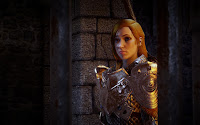
Evelyn Trevelyan from DA:I
DA:I's Evelyn Trevelyan
This was going to be a not-so-unbiased analysis of Dragon Age: Inquisition which I'm on record as not having liked very much. Instead we're going to compare and contrast Dragon Age: Inquisition and Dragon's Dogma: Dark Arisen in an epic battle of punctuation-bearing titles! Whereas I'm a lot more qualified to talk about gameplay and that sort of thing, don't think for a moment that I won't talk about writing here too.
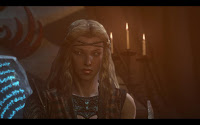

Arissa from DD:DA
DD:DA's Arissa
I like the Dragon Age series on the whole but don't like the trend it's on as we get further into EA's, errr, EA-ification of Bioware. Be advised that there will be many spoilers here for both games so proceed at your own risk.

Since I've written far too much about the subject over the last half year it took me to complete this thing, I've split this non-review into more-easily-digsted-chunks in an attempt to preserve our respective sanities and boost my post count. You can thank me later.

Movement
Anyone who plays action-y games will tell you that movement is a big deal. Can I tell where my character is? Can I avoid falling to my death skirting around the edge of a cliff to get a shiny? Can I complete jumping puzzles without Hulk-Smashing(TM) my hardware in frustration. MMOs tend to do a very good job with this as do FPSes. In RPGs it's more up in the air, errr...pun intended. Wouldn't you know it; we have a case in point right here!

Movement in DA:I felt floaty and disconnected to me. Most recent Bioware games have this flaw, Mass Effect included. I wasn't ever entirely sure where my character stood which made things like the aforementioned cliff work and jumping puzzles extremely frustrating. I had many a-plummet down what I thought was a scale-able piece of postcard-worthy terrain to an early demise. I would jump more in hope than in expectation. It always felt wrong to me in my hundred or so hours in game such that just about every precise movement attempt ended in profanity.  It plain did not work.
Why, yes, I would like a side of IK.

In contrast, DD:DA never left me wanting for control. Rather than being locked to jumping for vertical movement, characters in Dragon's Dogma can climb various objects and terrain features much like they climb monsters (but we're not ready to talk about that yet). Think of it as a fantasy parkour simulator if you like. As an added bonus, you get a bark and an animation if you get too close to an edge rather than falling to your doom. Nice. Character's positions are very tight and minus some issues picking up very small objects on the ground, I never had any difficulty judging where I could climb or moving around. My hatred of jumping puzzles is well documented at this point but in DD:DA I found myself climbing all over the goddamn scenery (and monsters) on a regular basis. Movement is precise and forgiving but way more important than that, it's predictable which makes movement based exploration very rewarding.

Unfortunately, neither game gave good mounts so that's a wash. DA:I's mounts are terrible making the already poor movement feel even more ponderous. You're saddled (sorry) with lengthy mount and dismount animations to go slightly faster confounding any attempts at picking flowers or rocks. DD:DA doesn't have mounts at all though Angry Joe's issues with fast travel are somewhat remedied by an eternal ferrystone granted in the PC port. Unfortunately, I didn't understand how useful they were until I'd seen most of the game once. The result was that on my first playthrough I spent a ridiculously long time watching my Arisen jog through the same scenery over, and over, and over again.

Presence
How much does your character feel like a part of the world? This is a big piece of immersion so getting it right is kind of a big deal. DA:I did a middling job of this. On top of having a very tenuous grip on the forces of gravity and friction, NPCs will mostly ignore you unless you get to a scripted cutscene area or something like that. Monsters are terrifically myopic with eyesight that doesn't reach as far as you could throw a large rock. The exceptions are pretty few and far between limited to scripted things like dragons and a couple really sneaky-seeming Varghests who seemed to be hunting me but were actually just moving relatively quickly about long patrol paths. Maybe Bioware's legendary dialog can save us.

While it's true that important characters like your companions and advisors (and whatnot) will engage in some well-VOed banter, it's typically at very obvious and well-scripted times with very few surprises. Said banter will change over time and inclination, some of which is very, very good. Furthermore, the composition and density of NPCs changes accordingly as time goes on and Skyhold goes from a ragtag group of refugees to a world power. Unfortunately, other than having more bodies about, it doesn't feel any more populated because you can't really interact with any of them--they're mostly a part of the scenery. Despite the fact that you've got somewhat of a divine aura and the supreme leader of this little operation, only the scripted ones pay you any heed. Not great.

DD:DA somewhat surprisingly does much better in this regard, probably because it seems to be less ambitious. Townsfolk will greet you as you're jogging by and each pawn you interact with will issue a pleasantry. It is the same pleasantry every time, but it is a pleasantry. If you run too close by non-pawns, they'll jump out of the way and issue a bark. Nice touch. As in DA:I, dialog will change as the plot points progress which makes those worlds feel more alive than they would otherwise seem. Caxton's lines did get old after a while, though. It was also a little weird during the endgame seeing shopkeepers feet away from a yawning abyss in the middle of the town rather cheerily going about their business.

DD:DA throws us an interesting curve ball. Attacking NPCs in the capital or otherwise causing trouble will promptly get you arrested and thrown into the dungeon sans most of your stuff. It even goes so far as swapping out your armor for something more appropriate given the venue. An interesting twist on the dungeon mechanic is that you're supposed to stay put for an in-game day (30 minutes). If waiting isn't your thing any more than it is mine, you can bribe a guard if he's nearby. Alternatively, if you have a skeleton key in your inventory you can use that one item to make an escape.

Doesn't look so tough.
The dungeon mechanic would be interesting in its own right but how it's used in the game is even more fascinating. There's a pretty straightforward quest involving a wrongly-accused gardener who's been throw in the slammer that you're supposed to bust out but that's not why we're here. At one point the duchess has you flogged and thrown into the dungeon to cover up for some, err, extra-curricular activities. Damage done, she'll deliver you a skeleton key to get out opening up a new quest and area. In a similar way, a "villain" once defeated (and rezzed) will end up in the dungeon which isn't really a place that most people frequent intentionally. In one of the few places in the game overflowing with exposition, he'll tell you why he did bad stuff and why he felt like he should turn himself in. He'll even give you his magick shield. I can't tell you which came first, the dungeon as a quest location or being thrown in there for being a nuisance, but both together are perfectly logical and helped me feel more rooted in the world.

Burnination in potentia
Bads also seem to be much more alive than in DA:I. Goblins will taunt you from afar if they see or hear you. There are traps set that will alert them to your presence sometimes resulting in ambushes. Big bads will spot you from afar and charge into you with the quest "Ambush!" popping up. Nothing prepares you for the first time you see a Chimera charging your position from halfway across the freakin' forest. In the much more boring daytime, you can generally spot them from a ways off, potentially preventing disaster. In the far more entertaining night time, you generally won't see the dragon until it's RightOnTopOfMeOhGodTheBurnination!

Gathering and Crafting
Folks have noted that both games suffer from MMO-itis when it comes to their crafting and gathering systems. For those unaware, MMO-itis is where single player parts of games tack on grindy things to keep people playing for whatever reason. In an MMO where there's a sub involved, this makes sense or at the very least we're accustomed to it. In single player games I'm not as sold. Both games have surprisingly expansive gathering and crafting systems so let's take a look.

DA:I's gathering system was clunky. If you weren't sharp eyed enough to see a few off-colored pixels in the corner in the distance you leaned, like I did, on the search key. The search key sent out a radar-like wave from your character and send back a ping if there was something interesting nearby. This was overloaded for hidden quest objects for which you'd get a different ping until you centered on it at which point it would start drawing that object.

I had lots of problems with this system. Crap was freakin' everywhere and my OCD has a really hard time not picking every flower, grabbing every stone, chopping down every tree, and killing All The Things(TM) to gather the bits they dropped. This means that I never wanted to use my mount because mounting/dismounting was such a hassle and goddamn it, I need that flower. This was doubly bad because at every camp in the field there's a requisitions officer offering you a quest that requires those same mob bits and rocks in bulk. Turn enough mob bits and rocks in to complete the quest and you get a couple points of power and the opportunity to do it again. I had no idea what power was for but it sounded real good so early in the game I'd scour the countryside for even more bad-bits and rocks for not a lot of utility.  Great.

The crafting in DA:I was similarly questionable. Whatever spare rocks and animal bits you kept around could be used to build things but only if you had the right schematic. These seem to have mostly been hidden in places I didn't look and the ones I did find were usually already obsolete. Some schematics made whole new weapons and armor but most of them built an upgrade like a hilt or haft or something to make an existing piece better. I ended up with a gajillion upgrades that I couldn't really tell apart and the UI for managing inventory was so clunky I didn't really want to mess with it. Furthermore, the handful of things I did craft were rapidly overshadowed by random crap I picked up in the next dungeon. Tedium + clunky interface == less fun than it sounds.

But lo, it gets worse! All those flowers can be used in alchemy which lets you improve or make new potions. Some potions you get an infinite supply of but others you need to manually craft. I got super excited when I upgraded my basic health potion right up until I realized that I didn't have enough of the T2 material to mass produce them. This led to much swearing and many deaths for the next two zones until I could find enough of the right flower for it to be a non-issue. A heads-up would have been nice.

So how did DD:DA do? We've got basically the same system here:  you travel around the country side picking up rocks and flowers and animal bits and use them for fun and profit--you know the drill. Most of the flowers can be used as is for a boost of health or stamina or whatever. For a nice bonus, many of these can be combined with other random bits to get a bigger boost to health or stamina or whatever. As a final twist, many of these curatives will improve if left in your inventory to age but only for a short while until they rot. Some bads will even rob you of your perishable curatives by making them rot with special attacks so that you can't boost your health or stamina or whatever. Neat.

On the gear side we lose the ability to make new gear (aw) but retain the ability to improve gear (yay!). In some cases, the total improvement is massive but requiring some rare bits from the toughest bads or flowers from the deepest dungeons conveniently located near the toughest bads, naturally. You can only upgrade equipment at specific vendors so it's typically the case that the old sword I've had and upgraded for the last 20 levels is still better than the shiny new one that hasn't been upgraded. If I survive long enough to get back to an appropriate vendor and have the right bits to upgrade, then it will be better than the thing I got right now.

No one said that dragonforging
would be easy!
This is already pretty good but it gets better. If you've defeated a dragonkin of some kind there's a nonzero chance that one or more of your items will be dragonforged. This change increases with the difficulty of the dragonkin in question (typically) and with the level of upgrade of the weapon. Once dragonforged the weapon gets even more powerful and unlocks a new set of very expensive upgrades. In this way, you don't have to give up your Sword +2 of Overkill--it'll dragonforge to a Sword +3 of Overkill if you're lucky!

I like this approach to gear because it encourages you to make investments carefully and increases the utility of those investments. Weapon-wise if you want to crank out the maximum amount of killage you are stuck with a very particular set of weapons which are non-trivial to get but there are still reasons to keep around certain older varieties too in order to put specific debuffs on the uglies you're killing. Armor-wise, the sky is the limit! With enough player skill, most obstacles are not gear-driven which leads to the game's somewhat unfortunate nickname: Fashion's Dogma.

Combat and Mechanics
Combat is a big deal since it's a lot of what you're doing. This is even more true if you believe that in games, much like porn, the story is only there to tie the action-y bits together.

In DA:I I picked a two handed warrior. This may have been what I played in DA2 but honestly, I can't remember. It seemed like a reasonable choice, really. Run up to bads and clonk them upside the head with a giant piece of weaponized metal and then take their lunch money. In retrospect this was a very poor choice and not just because the Inquisitor loses an arm. Two warrior parties in DA:I do not work. You split the most expensive armor across two characters and can't build enough guard without a shield to keep out of trouble anywhere it would make a difference. Thus, I couldn't take the hits to drop a sword and board companion and I couldn't keep up with a rogue or offensively specced mage. By the time I realized my mistake I was 40 hours in and too far along to be able to re-spec expediently. This is a classic mistake in RPGs and one that Bioware of all people should understand--don't force players to make the most important choice in the game before they have enough information to do so.

Combat just about always felt bad to me in DA:I. Since movement was so clunky and imprecise, I had no end of trouble standing in the right place. This was especially aggravating when winding up a long animation action and then having my companions knock the bad out of range. As a result, I never really felt like I had all that much control over the outcome, speccing issues notwithstanding. There was a very short span when I had a high powered weapon and was fighting lower level bads where I'd charge up and either Mighty Blow or Pommel Strike them into eating sand. The rest of the game was not as fun. Nearing the end of my time in the game I would actively avoid combat because it felt so tedious.

I was especially disappointed with DA:I's encounter design. Maybe it's because I'd done another tour with Wildstar but all the combat felt really dull. None of the mobs were really all that interesting and large mobs didn't move very well and weren't very engaging. Dragons were pretty much carbon copies of each other requiring fairly micromanaged control over your party to defeat cleanly. I stopped fighting them when I realized they were all more or less the same.

In stark contrast, combat in DD:DA feels vibrant and alive. Striders fly all over the battle field carving up bads like turkeys while Warriors wind up mega blows to knock down bus-sized uglies. Spellcasters are also very rewarding making the ground explode or summoning pillars of ice to climb on to get a higher vantage point.  Want more?  A fighter pawn with a shield or a greatsword can launch your character into the air to grapple with a flying bad or maybe a really tall one. Pawns can also hold a baddie down so that you can get a coup de grace. And don't think that casters are left out: two sorcerers can spell sync to halve the time it takes to rain fire down from the heavens.

That's just the beginning. Dagger users get a dodge roll with a set of i-frames to keep out of trouble while shield users can block to keep out of danger. Better yet, if you have good timing and can watch the actions of your opponent, you can execute a perfect block which will stagger your enemy and potentially do a mess of damage to them. How good does your timing need to be? One of the augments you can get will increase the window by five frames. That's right kids, five frames which is ~83ms as the game generally runs at 60fps and those five frames feel really significant when you're trying to perfect your timing. Assassins and fighters have a similar counter with similar windows--high risk and high reward. Nice.

As for the typical trope of choosing your RPG character's class when you have the least amount of information, DD:DA is way ahead of the curve. When the game starts you pick one of three base vocations by choosing a weapon (staff, sword/shield, bow/daggers). Advanced vocations show up at level 10 and you can switch at any point after that at any place you can rest so you're never really locked into a bad decision. The game even goes out of its way to make experimentation with other vocations a big chunk of the fun. Your hired pawns don't gain levels so you'll be replacing them regularly which means you'll see a wide swath of different gear and builds some of which will undoubtedly teach an observant player how different bits of it work.

At least there's only one.
And now we're on to the good part. If you've ever noted that you spend most of your time in most RPGs hacking at a big ugly's insole and wondered what would happen if you could, I dunno, climb up behind them and hack at their eyes or squidgy bits instead, then boy do I have a deal for you. Every bad has its critical spots and the larger the bad, the more critical spots it generally has. Applying damage to critical spots, naturally, does a pile of damage which is easy enough as long as those critical spots aren't somewhere inconvenient like beady eyes or the bottom of a foot or something. So if you have short but ever-so-pointy daggers, you really want to be climbing that ugly to put pointy-bit to squidgy-bit. The bads, also naturally, would prefer your pointy-bits not be applied to their squidgy bits and will bat, throw, grab, drop, burn, and otherwise try to throw you off. I can talk about this all day but you really need to see it in action to get the full effect. Go ahead, I'll wait. DD:DA's implementation isn't without its flaws but it is a cool idea that I wish we saw more often. Why do most games keep us hacking at big bads' insoles, anyway?

The beast part, though, is that in DD:DA, skilled play trumps stats just about every time. Stats do count--they make the margins a lot wider, but they aren't the be-all end-all that we see in most RPGs. Extremely skilled players can perform feats of daring-do with under-powered and under-geared characters making for some very entertaining highlight reels. I don't know that I've ever played an RPG with combat quite as enjoyable as DD:DA. For that matter, most MMOs don't achieve this level of awesome. For all of the game's other shortcomings, the combat is engaging and is why I spent so long with it.

Places To Go And Things To Do
In RPGs you pick up a lot of stuff. I think that's a rule of RPGs. One of the many annoyances I had with DA:I was that the interface is hella-clunky. Why can't I compare gear when selling the piles of cutlery and fashion I've accumulated? Why is comparing items so inconvenient in the first place? Why can't I vacuum loot in an area instead of interacting and watching yet another animation of my Inquistor bending down with my companions looking on awkwardly? Other games do these kinds of things, why not this one?

DD:DA splits up armor by location which makes generally usable lists but not weapons. Those get dumped into a single pile sometimes screening for things usable by your vocation. Similarly, your giant stash of consumables, rocks, and animal bits is neither sorted nor searchable. Good luck finding your eye of newt in there. Not much better, really, and if you play the game as much as I did, you end up with a huge pile of loot. Not the best, but moving on...

I feel like I spent a tidy chunk of my time in DA:I, say 15% which would be just over 15 hours of my life I'll never get back, waiting for things to happen. Not plot things or dialog, but transitions between things. It took freakin' forever to get into and out of the war table. We're in and out of the goddamn war table all the goddamn time. Are they hiding some terribad loading code? I played on SSD--no excuses. Just running around to talk to people at Skyhold took a really long time because the place was huge and apparently designed by a masochist. Cullen apparently had some pretty awesome dialog that I never heard because I couldn't freakin' find him! Mounting and dismounting which should have been a value add sucked because it took way too long but I've already ranted about that.

Flashback time:  DA:O had a pretty good balance of places you could go and a few things to explore. DA2 did a lousier job of this and went to a very linear map progression in a way that made the world feel very small and very disjoint. As if trying to correct for its predecessor, DA:I has some absolutely giant maps where it isn't immediately clear how to get where you need to or even what things are important. It's as if someone had just played Skyrim and really wanted to get some of that open world sandboxy goodness in a game that is neither open world nor sandboxy. This turned DA:I into a lot of tedium trying to figure out where crap was. Bleh.

In this respect, DD:DA fares only slightly better. It's both open world and sandboxy so it benefits from very large areas. Unfortunately since it's super easy to not understand how port crystals and ferrystones work it seems like you spend an awful lot of time watching your character run from place to place. Not great. This is not helped by the fact that mobs will spawn at the same point between just about every time you pass through the same locale. At least they switch up to harder bads as the story progresses. I'm probably in the minority here but I was mostly OK with fighting the same bads at the same points because the combat loop never really got old.

Adding to the difficulties in DA:I, quests tended to be very tedious and there were far too many of them. Every dungeon had at least one scavenger hunt. These ranged from trivial to ridiculous often revolving around collecting dungeon themed tchotchkes. Collect 15 soul shards. Collect 7 idols. Find 12 ancient glyphs of boringness. Sometimes these things were required to move on. It's like a Doom key quest puzzle but often less sensical. Why do I need 9 mummified bat wings to convince the Elvish-magically-sealed door to open? Are they peckish after their thousand year sleep? The game was not better for the majority of these and the dungeon does not need to be made "more interesting"--it's a dungeon; it's already interesting.

DD:DA does slightly better. While there are piles of quests, mostly of the kill variety, they aren't necessary though sometimes the rewards are useful. It's also mostly true that you don't generally need to go out of your way to complete them--they happen very organically while you're off gallivanting across the countryside or traipsing through the main quest line.

Moving on to encounter design we see another large discrepancy. DA:I's encounters were largely uninspired. Maybe it's because I'd played so much Wildstar; maybe it's because they were freaking boring. Dragon encounters in particular have my disdain as being mostly carbon copies of each other and not especially interesting or well thought-out. This is doubly true for the random packs of mobs scattered across the world. With a few exceptions, they're spaced out very regularly across the countryside without much consideration of what they might be doing there. MMOs do this for a variety of reasons none of which apply to a single player game.

This is how dragons should look.
DD:DA's encounters on the other hand are a lot more dynamic. Fight a flying dragon by shooting out its eye to drop it on the ground? Check. Jump off the scenery to grab onto its tail as it goes aloft. Yep. Grab onto its head and go to town on its sensory bits before it grabs you and slams you to the ground? Yes, please. It gets better! Fight too near a ledge and tumble to your doom? Yup. Convince an ugly to charge you near that same ledge and dodge out of the way so it can plummet to its doom? You betcha. Now shake it all up for various other vocations each with their own strengths, weaknesses, and strategies? It's as if they know my kryptonite.

Flip the Record Over and We'll Continue on the Other Side
I sometimes wish that blogger had a word count but right after that thought I become very frightened--I don't think mankind is ready for that kind of power! As such we're going to end this one right here on this particularly happy note. Sanities are being preserved right now, people. 


2016/07/27

My Post Count!!!1!one


In a blatant attempt to rescue my post count in a rapidly ending year, here's some art.

I'm starting to learn how Manga Clip Studio works but it's not going fast.

This is De'elah.  She's been here before though probably a really long time ago and maybe not on this site.  She'll probably be back again at some point.

I won't talk about how long this piece took mostly because it's embarrassing especially given that I started with an OK sketch (from 2004, no less).  Nor will I talk about how badly I screwed up the shading.

I will say that I needed to be done and it was above my admittedly low minimum suck bar.   So there's that.

2016/05/21

2016/04/30

Freakin' Blogger

I think I broke something. Actually, I know I broke something.

All I really wanted to do was change the widths of things. Blogger insisted that I choose a new template so I did. Comforted by the "Edit HTML" button, I changed font colors and widget layouts and whatnot and, well, you see the results. It's bad.

You see, the happily reassuring "Edit HTML" button is a lie. What lives in the templates for this site is no simple HTML despite what the template name might claim. No. What lives there is true and unabashed evil-tude.

I may try to hack up the HTML evil that lies at the heart of this site. More likely I'll become a giant squid of anger and reload the old template with its barely legible text and super narrow columns.

Seriously, people, when changing simple things in a goddamn blog template are mind-jarringly complicated, it indicates that something has gone very, very wrong.

2016/04/09

Less Sketchy

Meh.  Still needs work.  Someday I'll learn how to use my tools.

Also:  how is it April already?!

2016/01/01

2015 In Review

You might not be surprised to hear that I start my increasingly traditional "Year in Review" posts right after I post the previous one. While this sadly doesn't stop them from sucking, it does improve their accuracy!  This one squeaks in just before the deadline for...reasons that will be obvious by the end.

New Digs
I've moved!  Again!  This time, it's back to New England (boo!) but in a new state entirely (New Hampshire).  The motto here is "Live Free or Die" but I always think of it as "Live, Freeze, then Die".  Because it's cold.  And I arrived in the middle of a historically bad snow storm.

New Digs
I've moved!  Again!  And no, that's not a copy and paste error!  My current employer decided that one cross-country move in a year wasn't enough so they decided to relocate me to the greater Seattle area. There's good and there's bad with that but if I'm honest, I was good with one move.  As a result of spending roughly half the year moving, there wasn't nearly enough gaming this last year as I would have liked.

Well, Crap
No one actually likes the formalities.  On to gaming!

Broken Age (Act 1, 2014):  ***
I backed this on kickstarter and only got to finishing it this year. Broken Age is a lot of what I like to see out of games but glaring in its omissions.  Style and charm it has in spades.  Substance and depth it lacks.  I suppose I can let the latter go since that's not the kind of game it is but I was reminded of this rant about adventure games more than a handful of times.

While I didn't have any legitimate "throw the controller" moments, I did get stuck at one point last year and didn't get back to the game until March while trying to free up space on my games drive by completing games I hadn't yet finished.  First world problems, yo.  There is some legitimately good writing in this game, however, and (also, unsurprisingly considering the roll call) some legitimately good voice acting.  I'll also award a star for the soundtrack which was both exceptional and seemingly an exception in this day and age.

I haven't yet played Act 2 and I'm not even sure if I own it but it's on my list of things to do soonishly.  Maybe in 2016?  Check back in a year and find out!

TotalPlanetary Annihiltion (2014):  **
If you've read stuff here you know I'm an unabashed fan of Total Annihilation.  Planetary Annihilation was supposed to be the same thing turned up to 11 which is why I gave them quite a lot of kickstarter money.  While they got a lot of the bits right it unfortunately doesn't come together well at all.  I wanted to like this one--I really did--but no.

There is way too much micro which is completely against what it's supposed to be. Planets are too small, moving units between orbital positions is way too hard especially when your opponent is entrenched, and if you slip up in your defensive strategy even a tiny bit or heaven forbid don't have the tech available, it's more than likely you'll get hit by a showstopper like a nuke or an orbital laser or god knows what that you cannot recover from.   Even on the easiest setting ("normal", no less) it is almost impossible to beat any faction leader showdowns in Galactic War mode.  The other encounters are comparatively a breeze.

I gave up after a sickening number of hours trying to figure it all out. This game needs two of three things and I don't especially care which:  1) put in an easy mode so I can learn, 2) put in a tutorial so it's not a learning cliff anymore, 3) put in a "no extra planets mode" with extra large planets so I can avoid the worst part of your game. We are more than well taken care of when we want a RTSes that emphasizes APM (real time tactical more than real time strategy, really, but no one seems to know the difference anymore).  A spiritual successor to Total Annihilation should not be one of them.

Spell Force: Breath of Winter (2004): ***
I like the SpellForce series which is why I was happy to see that the expansions were finally all available in the US and on Steam.  This is a game that I've now bought twice, the first time in no small part because there was a pretty girl on the box.  I'm not without my vices, I suppose.  I thought I'd written about my fun in Spell Force up in here somewhere but I can't seem to find any evidence mostly because I can't be bothered to look.

It might have been because I'd just played Planetary Annihilation but the game seemed very primitive. I suppose that's to be expected given that the original was released more than a decade ago. Whether it was the English SKU for the US market that didn't get enough love or it being forced out before it was ready, there were parts of the game that were poorly executed.  Difficulty was all over the map so even though I ended up doing many Ridiculous Feats of Farming(TM) through a lot of my playthrough, parts of it were stupidly hard.  I don't think it was quite as good as the original SpellForce but that's not uncommon for expansions.

I'd intended to play the last piece which is why I got the trilogy on Steam to begin with, but it didn't work out that way.  Next This year, maybe.

Caribbean! (2015): ***
I really struggled with the rating on this one.  On the one hand I got all the tall-shippy goodness that I've so missed from Ancient Art of War At Sea.  On the other hand, the are parts of the game that are very, very unpolished mostly because it wasn't done (playable beta, basically).  If nothing else, it's a Mount & Blade engine game so I can, and did, mod the shit out of it.   For a good couple months this last summer, this game sucked up all my attention.

Around the time that I was de-dustifying this post near the middle of December, I was somewhat surprised to learn that the full game was released as Blood & Gold: Caribbean! which is in fact entirely too many punctational characters for any game name.  I forgive this fact because I was granted a Steam key since I'd bought the early access version.  This Next year we'll see if you really can have too much tall-shippy goodness in one year.  I have high expectations.  I may be disappointed.

Wildstar (2014):  *****
Wildstar went free to play this last year, right around the beginning of October.  "I'll just take a peek and see what they did."  It always starts that way, doesn't it?  It didn't take long to get sucked back in and it's super easy to lose yourself in this kind of game when you're working a thousandy-billion hours a week.  I probably won't do a multi-page write-up for it so this'll have to do.  Some things are better (smoothing of difficulty curves, reduction of lame grinds, easier attunement, better pricing).  Some things are worse (crafting, in your face cash store, mudflation in spades).  Some things are still ugly (ilvl, community toxic as ever, piles of bugs some of which have existed since launch).

Despite the fact that they did their damndest to kill it, despite the fact that I have no one to really play with, despite the fact that it's a game that probably doesn't have a future, and despite the fact that I have very few remaining in-game goals, I find myself playing just about every day and I still love it. The combat loop is exceptional and I'm on record as having said that killing mobs never stopped being fun which is still true.  When the eulogies start rolling when NCSoft finally pulls the plug, remember that you heard it here first:  Wildstar was a gem of a game that was fantastic in spite of itself.  (Also:  I totally nailed on the free to play thing.)

I think it's run it course and I've been free for a few days now due to the next and last item in my list. That's what addicts say, right?  "I can quit whenever I want!"

Dragon Age:  Inquisition (2014): **
Alas, poor Evelyn.  If only she had been in a better game.
Evelyn Trevelyan,  warrior noble.
Her eyes are very blue.  Are they
too blue?  Is that a thing?
Going back in Teh Historys(TM) I note that I rather liked previous Dragon Age titles (as seen here in 2011 and 2009) but memory doesn't hold as generously.  I remember Origins as "The Game in Which I Was Deprived a Good Ending(TM)" and DA2 as "The Game Which Was Terribly Disjointed(TM)". DA:Awakening I barely remember at all if I'm honest beyond Shale who was awesome.  DA:I was super well-received by the press which is usually a bellwether for a game that's overrated and experience drives this point home yet again.

While the world is a lot more cohesive than in DA2 I feel that it is a heck of a lot less well polished as a game as opposed to as a screenshot engine for which it is more than adequate.  The interface is terrifically clunky which led me to miss out on some important stuff early on and there's a lot of tedium just doing normal things.  The maps are too large and I spent what seemed like an eternity moving back and forth over the same points over and over (and over) again even for what should be easy and rewarding things like talking to my crew.  When you can turn what should be the best part of the game into tedium, you know there's problems.  Then we get to the length--it's a huge game easily spanning 80 hours (I was nearer 100 though I understand you can do it in under 20) and at many points I just wanted it to end so I could get on to other stuff. This is probably how I will remember DA:I--"The Dragon Age Game Which Was Too Tedious."

I was going to say some stuff about good writing and Bioware and blah blah blah but no, not this time.  I found the writing to be, on the whole, very average.  Any other game from just about any other studio, I'd probably list this as a high point.  For a game with what I have to believe was a nine figure budget (the intertoobs are failing me on this one) from a studio that used to be known for fantabulous writing, no.  People far smarter than I have said some stuff worth reading.  I may follow suit and do a bigger write up.  I figure I might as well since I spent all that time with it.

So There You Have It
That was my 2015 in a nutshell.  Now, pardon me for a moment while I prep next year's post.

2015/09/05

More Sketchines

Charissa
Charissa
Sketchier but faster done earlier this last week.  She's sposed to have chain mail underneath but that didn't come through.  I went with a completely impractical half plate getup because for story reasons she's not supposed to be without her shield.  The weapon is because we don't see nearly enough hammer warriors.

More to come!

2015/08/27

Sketchiness

Genoveffa
Genoveffa
In an attempt to rescue my post count this year, here's some art.  Earlier this year I switched from ArtRage (which I still like) to Manga Studio (which I like more).  It has more of what I'm looking for in easier forms to use which seems like a win.

I've also started working more from reference which hopefully comes through.  I'm hoping I can do a piece every couple weeks at least and start doing faster cleans and colors and such.

Hopefully poor Geno won't end up on Repair Her Armor. Next one won't be as cheesecake-y, I promise.

2015/06/14

How is 2015 already half over?

Is it just me or is this year flying by?  Moving cross country (sadly) back to New England hasn't helped but it still seems like it shouldn't be June yet.

So, uh, I should update here more or something.  You know, before the year is done.

2015/01/01

2014 In Review

Clearly I can't get enough of these.  This is partially because it means I beat the odds for another year but mostly because I get to re-live the year of gaming.  But First!

New Wheels
Isn't she lovely?
This year I bought a new car. As seems to be the trend, each new vehicle is more refined and more powerful than the last. At this rate, the next one should be able to fly and do my hypothetical math homework.

This would be the new-this-year BMW M235i.  Yes, I know it isn't a real M despite the many (many) badges.  No, I don't care.  This is far and away the nicest thing I interact with and by a huge margin.  (For those wondering:  I still have the Sky.)

Another Show, Another Trophy
I didn't blog about it, probably because I was too busy playing Wildstar, but the new Jag took Best Space at BrickFiesta 2014.  That puts me at 4/4 for those keeping track.  Next year (scheduling gods pending) I hope to do something completely different and at more reasonable scale which might end my streak.

Now That Formalities are Complete...
...on to gaming!  The list below might look short but don't be fooled. Some of those represent a lot of time involved.

Divinity II:  Ego Draconis (2010):  ****
While I ultimately don't think D2 is quite as good as Dragon Age I think it stands out in a number of key ways.  For one, you get to be a dragon an rain hellfire and brimstone upon things which is pretty neat.  Second, they have a pretty good lore going on with a lot of callbacks from DD and BD which is always appreciated.  I think the combat in general and pacing at the beginning of the game could use some work, the completely open skill trees as in all Larian games is very welcome.  The controls on the other hand are a little floaty, jumping especially, which sucks in the many jumping puzzles.  I still can't decide whether I like the ending with its Bioshock-esque fourth wall breakage but it's nowhere near DA:O or ME3 in the enjoyment ruining department.

Divinity II:  Flames of Vengeance (2010):  ***
D2:FoV is an expansion to D2 which continues where the original left off and is likely a lot of the stuff that was cut from the original game during its somewhat (typical) difficult birthing.  In my case this was extra good because I didn't dwell on D2's ending.  FoV isn't as good as the main game.  The bulk of it is a bunch of fetch quests across Aleroth with the requisite (and sometimes imposing) appearances of characters from the first.  But when the plot hots up, it opens up into a single well-paced dragon-shooty arcade sequence which is by far the best part of it.  Lots of stuff is resolved but in true Larian fashion, not everything so there's hope that there's more D2 on the way.

Rage (2011):  ***
Rage is dated in all the ways that people have already been critical of though because I had such low expectations I was pleasantly surprised. At its core, it's doom with prettier graphics so basically a linear corridor shooter filled with monster closets.  The driving was surprisingly good especially since I typically hate driving in PC games. I've heard second hand information that its development was a disaster and it shows in its unpolished and short playtime (about 15 hours all told).  I suspect that having corporate overlords for the first time has something to do with that.  Ultimately not a terrible game but I don't think it does justice to the legacy of id.

Wildstar (2014):  *****
With a little bit of effort you can probably find some crap I wrote about Wildstar.  It's a game that I liked a lot but ultimately couldn't budget the time for given that it isn't the kind of game that can be easily budgeted.  There are some great ideas in it, ones that I hope will see the light of day in other games because I don't think it's long for this world.  That's a shame because Wildstar is everything this industry needs:  style, substance, and character.  If you forced me, I'd probably say that Wildstar was more fun than GW2 but that GW2 was a better game.  Make whatever sense you like out of that.

Dwarf Fortress (updated for 2014):  ****
I don't know if I'm completely comfortable calling DF a game as such. It's kind of an ant farm with questionable graphics where you have slightly more control over what the ants, err...dwarves, do.  I actually started playing this on and off years ago but somehow it never made it onto my year end reviews.  With this year's version I decided that I'd really get in and try to understand everything which, if you don't know the game simulation ant farm, is hugely improbable given the depth of the simulation.  The primary difficulty of DF is that most of it is really mundane and can be quite boring.  These vast swaths of blandness is punctuated with moments of pure hilarity like losing the corpse of a recently slain dragon only to find that your dwarves have butchered and cooked it.  That's its strength:  the stories you get to tell to astonished and terrified onlookers beggar belief.  I got involved after reading the chronicles of one, now quite infamous, Boatmurdered. Bronzemurder is nowhere near as infamous but still displays the essence of DF:  unthinkable tragedies followed by improbable victories and retold in increasingly amusing ways.

So that's it.
Seems shorter than it actually was but that's kind of how I sum up 2014.  Tune in next year when we recap all the crap I did in 2015!

2014/12/13

Wildstar: The Ugly

All that's left in my coverage of Wildstar is the stuff that really sucks some of which I'm certain pushed people away from an otherwise good game.  If you're a fan of the game (or heaven forbid, a fanboi) you would be well advised to look away.

Overtuned Encounters
My guns...they go here.
Every single dungeon has at least one overtuned encounter and not necessarily the last boss.  Stormtalon, Slavemaster Drokk, Deadringer Shallaos, and the dreaded mining run in Skullcano immediately come to mind.  Due to the way these encounters are set up, there are either very thin margins of success for adequately- but not over-geared folks, or a dance that is way too hard to get right consistently usually in the form of positioning and especially for medium to short ranged classes.

On Stormtalon, any early death in a knockback phase, DPS or otherwise, dooms your group to failure if one of you isn't terrifically over-geared.   If you're lucky enough that it wasn't your healer or tank who died, you'll either not be able to do enough DPS to down him before your healer runs out of focus or you'll not have enough interrupts after the knockback phase.  For Drokk it's usually either the homing bomb phase, particularly during the switches, or the tether + suppression wave phases.  I could go on but I'll spare you the details.  If you've played the game and done these encounters, you already know what I'm talking about.  I'd leave some fun youtube wipes here if you haven't played the game, but apparently Wildstar is too hardcore for that.

Some of these dances are so complicated with margins so thin that any early death for groups not stupidly overgeared ensures a wipe. It's hard on tanks and healers in particular but there are no unskilled positions in Wildstar.  I strongly suspect that if these had been loosened up early in the game's history that it would have prevented quite a large number of rage quits.  Most of the group I played with quit as a direct result of one or more of these overtuned encounters and that sucks more than might be obvious.  More in a bit!


Antisocial Design
At launch, a huge number of the game's designs were antisocial. What do I mean by that?  Any feature, encounter, reward structure, or otherwise confluence of mechanics in your design that causes players to actively screw other players out of anything (especially time!) is an antisocial design.  Wildstar had these in spades at launch and though they've fixified some of them, many still remain.

The first and most egregious example is "gold or bust".  Adventures and dungeons at launch had a guaranteed epic if you completed them well enough to score a gold medal.  Gold dungeons were and still are largely out of reach for most folks, but gold adventures are fairly routine.  For many of these, player deaths aren't a strict failure case but this wasn't well understood due to bad or malicious information. Spend 30 minutes in queue as a DPS, finally get a pop, then watch some chump quit at the first death with others sure to follow.  "Gold or bust."  Better yet, wait the same 30 minutes then watch one or more players quit because you're the same class and they'd have to roll on their epic.  Great.  Not everyone who played was like this for certain but enough were that it was a frustrating experience a lot of the time.  Carbine's fix was to make epics extremely rare even if you did get gold, so other than doing attunement runs for your pals and trying to avoid daily zones to cap elder gems, no one really runs these anymore.

This gets worse for dungeon runs.  Up until recently, there was no real reason to go back and try for a gold dungeon run once you were past the dungeon step of attunement.  Because of the difficulty of completing dungeons, a lot of folks swear them off altogether even when this means their friends are left in the cold. It's easy to say "find better friends" but in practice the rewards should be better to offset some of the frustrations of teaching the dance and wiping over and over (and over and over and over) to yet another set of folks.

One of the more controversial pieces of antisocial design is in PvP.  I did not do much PvP in Wildstar (odd for me) and I kind of dodged a bullet on that one.  All damage is basically halved for normal gear to get around the silly mudflation plaguing most games.  Instead you get PvP ratings from special PvP gear for offense and defense which can raise the effectiveness of both.  The results are almost comical.  Get into a PvP match with no PvP gear at 50 and you will eat dirt with alarming frequency.  The discrepancy between PvP geared folks and everyone else is night and day even though they've gone through and retuned it a bunch of times.

Rewarding the victors to an extent that hurts competition is what we used to call "Counterstrike Syndrome".  It's named after the game where in a multi-map rotation the winners can buy much better guns exaggerating skill differential between teams. Wildstar has this in spades where those who spend a lot of time in PvP who are already more experienced also get piles of PvP gear which puts them head and shoulders above folks testing the waters.  (An example of this idea well executed is  GW2's structured PvP for interested parties.) Earlier levels are less bad since the cap on PvP currency is small and gear is replaced often.  At level cap, however, the gear differential can be so high that there's no real way to obtain that gear for new players except by being worked over for days on end.  This is always bad but it's especially bad in a game bleeding players. Cannibalizing newcomers with awful introductory experiences ensures that the mode will die.


The Live Team
Most of the game's shortcomings were as obvious as a boss's telegraphs.  Yet it seems that the designers and live team either weren't aware of it, didn't want to do anything about it, or couldn't do anything about it.  Determining which of these is the most tragic is left as an exercise for the reader.  So far, we've barely scratched the surface of the brokenness, most of which should never have seen the light of day.

Solutions to bugs, especially balance issues, were very late and often arrived in giant batches.  Carbine's development cycle rolled small important fixes and tweaks into much larger drops with new content which unduly delayed them.  Content drops, when they arrived, came without time on the public test realm (PTR) sometimes completely unannounced and often very, very broken. Hotfixes have been fairly common after a big drop and often even the things that were known to be broken in whatever PTR versions were available were still patched to live regardless.  Sometimes the fixes (even the correct ones!) were worse than the issues they were trying to resolve.

The fabled "Drop 3" which comes with many (many) fixes some new content, and yet another serious rebalancing apparently dropped within the last few weeks.  (I've not been playing so I'm not entirely certain.)  We hadn't seen a reasonable set of fixes since August and even that one was both small and broken.  Gamma Rays anyone? Players are fickle and won't wait around forever for you to fix your broken game, especially when there's a sub attached and even more especially when your fixes come with even more brokenness.

Carbine's live development process has the trifecta, then.  Their changes are late, often "fixing" the wrong things, and often with serious game breaking bugs or further worse design.  A slate of firings and public figures quitting paint a dark picture of the remaining development effort which further reinforces the notion that the game is dying, true or otherwise.  This is no way to run a live team.


The Roster Boss
The roster boss is ultimately the winner in any game but Wildstar, through some combination of its foibles and its demographic, lost players at an alarming rate.  You usually see a fairly dramatic dropoff at the 1 month, 2 month, 3 month and 6 month billing cycles.  After that it plateaus for a while with upward spikes when new content is released.  By my estimation Wildstar halved by the end of the first month and halved again at the end of the second and third months.  I played on a low population server before the merges and by the end of that third month even the capital city was nearly a ghost town.

Eventually Carbine announced "megaservers" which basically rolled all the servers sharing a ruleset in a territory (except RP servers--sorry guys) onto the same server.  At the same time they opened up free transfers to a couple of the larger servers.  Many servers who were already on the ropes, mine included, crashed and crashed hard. People left in droves to the more populated servers which broke economies, guilds, and communities.  This is dicey at the best of times and I honestly think that free transfers plus the four-ish weeks that it took for megaservers to arrive (that's pretty close to forever in internet time) did more damage than good.

This brings us to one of the worst parts.  When you lose a member of your team, it's a big deal.  This is someone you probably learned those dances with who knows how your group operates and who, if you're reasonably successful, plays at a high level.  You cannot slot a rookie and expect to have the same success.  Gearing issues aside, the game is just plain too complicated and after a couple cycles of teaching new folks to dance it starts seeming more like work than it does play.  Once enough key people leave you stop being able to make any progress and after that, it's hard to keep playing.  This is what ultimately broke the game for me so I feel especially ranty about it.

What's worse is that this wasn't just my experience.  I spent months trying to coordinate a multi-guild alliance like we had in WoW almost a decade ago and every guild had the same experience: healthy numbers to start with a steep drop off after two or three months.  If you weren't inviting anyone who still drew breath, you were dying. Once guilds stopped being able to make progress they broke up with a large portion on of their members never to be seen again which further depleted the pool.

My best theory is that people bolted once they hit level cap and started banging their heads against attunement. At release in WoW, leveling to cap took months and there were very few brick walls.  In Wildstar, leveling to cap takes a tiny fraction of this and brick walls come early and often.  This is awfully similar to what I observed in SWTOR. I think that short solo content to cap with a de-emphasis on grouping hurts the longevity of these kinds of games because there isn't sufficient time or reason to build lasting relationships.  Without lasting relationships you can't have long-lived social games.  MMO design in this day and age is pushing toward more streamlined and casual experiences, Wildstar included, which effectively reduces their stickiness and may be a death knell for the genre. As a fan of these kinds of games, I have never wanted to be wrong more.


Postscript
It's as fun as it looks.
So that's Wildstar in a nutshell, at least from my perspective. I strongly suspect that NCSoft will not allow the game to limp along at its current subscriber base. I predict that it will either go free to play next year or their corporate overlords will pull the plug. That's a shame because for all their mis-steps, it is a fantastic game and one that I've enjoyed quite a lot for quite a while.

I'm reminded a lot of Vanguard which had a terrible launch but despite its flaws was actually a very good game. The industry and gamers alike desperately need more games like Wildstar.  As a fan of the genre and the biz, seeing a game with so much promise fail so quickly is very, very hard.


2014/12/11

Wildstar: The Bad

As not-so-subtly alluded to in the previous post, not all is well in Nexus.  Big surprise, right?  Some of it is downright awful but we'll save those for last.  These are the bad things, not necessarily game breaking, but frustrating and a mar on an otherwise very good game.


Death Taunts
This one's easy:  every time you die, an announcer taunts you.  Every. Freaking.  Time.  If things are good and spirits are high these are sometimes amusing.  "If you like living so much, why do you keep dying, hmm?"  When things are down and you're frustrated, not so much.  You might wipe dozens of times trying to learn the dance for a particular encounter.  "You just be tired of dying over and over again.  Dead tired, heh.  Get it?  Ahahaha!  Dead tired."  The group I played with wiped for three weeks on the final boss of the first dungeon alone.  It got very old very quickly.

This is one of the few writing and style missteps in the game and it's a doozy.  "Aw, what a shame, I planned such a lovely funeral for you." This doesn't make the game better and poking an angry bear doesn't seem so smart.  "Do you have a death wish?  So do I!  I wish you'd stop coming here!"  I don't have any statistics to back this up (not like Carbine had a survey of why people quit for the first few months) but I suspect a nonzero number of people bailed because they got sick of hearing these.  "Maybe you should take the hint."  Don't kick your players when they're down.

I'll just just leave this here for the morbidly curious.  (I couldn't help myself!)

The UI
We interrupt this rant for a pretty picture.
Wildstar's UI isn't outstanding. It misses the mark about as much as Rift hit the mark so many years ago.  On top of being slow, it's also clunky and without much consistency.  As someone who's worked on MMO UIs in the past, I know that it's a high cost and low reward kind of thing but I can't help but feel that Carbine could have tried just a little harder.

One example that caused me great consternation was that mail isn't always available.  Mail in the game works in two basic ways:  you can read any of it and take cash from the little icon in the bottom left. Attachments have to be grabbed from a "physical" mailbox somewhere in the world.  Settlers even have an ability to plunk one of these down for a short duration--handy!  Unfortunately, if you log in, then log out, then log in again, your mail is not available, sometimes for quite a while.  I suspect this is either to reduce bandwidth costs or intended as a way to curb the botters that plagued the game's release.  Either way it is super, super annoying for people (like me) with a lot of alts.  I suppose it could also be a bug.

The guild roster display is another example.  Until many months in, there was no way to show just the folks who were logged in.  As we'll discuss later, the roster boss looms large and it isn't uncommon to have way more people offline than online.  There is a mod to fix this and to Carbine's credit they did eventually add it to the base UI but it should have been there at launch and probably wouldn't have taken all that much effort to add.

One of the more interesting examples is one of the myriad ways that crafting can fail.  Go to a crafting station, play the little mini game, click the make-shit-happen button, watch the bar fill up and then...nothing.  No failure, no messages, no nothing.  The bar fills up and that's it.  You have to cancel out, saving your items in most cases, and try again.

The problem?  You're mounted.  It is extremely uncommon to not run around in city and overworld zones mounted.  The game (for whatever particular reason) has decided that you shouldn't be hoverboarding and crafting at the same time and fails.  Months after launch, Carbine acknowledged how annoying this was and made it so that you'll be automagically dismounted if needed when you start crafting.

New problem:  start crafting and cancel out leaving your materials at the table.  Now you can't mount at all!  The game doesn't bother telling you this.  You click the mount button and it does nothing.  At best, it just looks broken.  Notice this when you're far away from a crafting station and you'll be very sad.  Luckily most of the time you'll be able to get to housing where you can hopefully access one or more tables.  Why is it like this?

The game is playable with the base UI but it isn't good a lot of the time.  Small frictions add up over time and UI is generally one of the safer places to make changes at launch.  While they did address issues, it was painfully slow which we'll talk about in more detail later.


Mudflation
Before we really talk about mudflation we have to talk about the game's tiered content and gear.  For those of you who played, this will be dull.  Sorry.  There are five (or so) basic tiers.  In relative order of difficulty and coordination these are:  overworld questing (usually solo), adventures (5 person instance), dungeons (5 person instance), small raids (20 person instance) and large raids (40 person instance).  There's other minor bits like group mobs and world bosses and whatnot as well but those are the basic ones.

Gear rewards generally follow the same kind of pattern:  greens and blues for overworld questing, blues and epics for adventures, better blues and epics for dungeons, etc.  Crafted gear rather breaks the mold since it can be tuned to specific builds/stats/whatever within some loose guidelines.  In fact, the tuning is so good that specific bits of crafted gear outperforms many small raid rewards.  Carbine has said in the past that they didn't really expect people to min max quite like we do. I don't know why they wouldn't expect that!

Of course there's more!  Up until recently, all reasonable gear had a sometimes wildly variable number of slots of completely random types. One to four slots on blues was not uncommon.  If you were lucky you got a piece you cared about with a bunch of slots.  If you were luckier than that they were the good slots where you could stack the things you cared about.  The amount of yield for sticking a rune into a slot scales with the tier of the gear being slotted.  This effectively compounds the differences between tiers three times: base stats, rune slot count, and rune slot yield.

Remember how housing harvesting plugs gave a limitless surplus of easily gathered resources?  Clever players did exactly what you'd expect:  they burned piles of crafting materials to make that one piece with exactly the right slots and the highest slot count, dumped the reasonable results on auction, and salvaged everything else. This is part of why crafting gear performed so much better than its intended tier. Crafting resources generally aren't scarce in Wildstar and I can only imagine how much more non-scarce they would be without people constantly draining supply trying to get that one perfect piece.

You can probably see where this is going.  The difference between questing greens and crafted blues is enormous.  It is not unheard of in the circle of folks I played with to almost instantly double their effectiveness upon hitting 50 and getting decked out with new gear. Also as expected, there's a jump between adventure/dungeon blues and 20 person raid purples which is just about as big and another similarly sized jump from 20 person raid purples to 40 person raid oranges.

The effect of wild differences in gear level on the game is disastrous given the relatively straightforward damage mechanics.  A DPSer in tuned and runed crafted blues can easily double the output of an equally skilled player of the same spec and class but in unruned and untuned questing gear.  While the skill cap is higher in Wildstar than it is in many games, it isn't high enough to offset the difference in gear tiers except in the most lopsided cases.

Large differences in effectiveness trivializes the majority of the encounters in sometimes non-obvious ways. Doubling group damage halves the time spent in any encounter stage which usually translates to half the time of the dance in that phase.  Recall that most of the difficulty of an encounter is in the dance and that some of those dances are goddamn hard.  I suspect that this was at least partially done so that older content becomes easier for those who have run it a lot but Wildstar takes it to an extreme level that effectively robs itself of one of its best aspects.


Time Gates
This is a normal 'slinger Gate, not a time gate.
And then we get to the time gates--tried and true methods of keeping players occupied until more content arrives. Wildstar has a lot of them and they were even more plentiful when the game was new. Want to raid? One of the first steps is buying your key which costs slightly more elder gems than you can get in a week. Level cap early in the week? Well, you're stuck waiting (but enjoy your increased income!) until scheduled maintenance. Think you'll be clever and get a headstart on the next parts of attunement? Don't bother, they're (mostly) not retroactive.

Then there's the rest of attunement.  The process is long and can seem convoluted and at launch had steps that were pretty freakin' difficult.  Some of those steps were even broken.  The first hurdle is usually attaining the highest level of reputation with your faction. Even doing every quest and every dungeon pre-50 you still wind up thousands short.  This means that you have to grind it, except that for most people there's nothing you can effectively grind outside of dailies.  At launch there was one daily zone which is usually crowded and you might get 750 rep for clearing.  I guess it's something to do while you wait for the week to reset your elder gem count but it gets dull very quickly. Content additions after launch including new zones help but it's still a pain.

The next big hurdle is to silver all four adventures, some of which are extremely buggy.  Tempest Refuge, anyone?  A couple bits and pieces after adventures and you needed to silver dungeons.  Silvering all four dungeons entails clearing all objectives within a very tight time window unless you massively outgear dungeons at which point you don't really ever need to go back.  They did eventually change this to only needing bronze (all objectives but not timed) but I suspect that half of the game's subs were already lost by that point but we'll rant more about that in a bit.

Once dungeons are complete there are more bobs and bits and then you need to kill a mess of world bosses which are on long spawn timers and often broken.  Now you can raid!  Prior to the change to only needing bronze dungeons there were very, very few people who were attuned and a great many of the raid encounters were broken too.  This never felt necessary--why hide your best content, the reason so many people tried your game, behind such a grind?

Crafting at 50 is also heavily time gated.  Upon hitting 50 you'll receive a trivial fed-ex daily quest from your trainer in the capital city.  Completing this quest gives you between one and four Eldan data fragments.  The vast majority of times it was one with a seemingly tiny chance of giving more.  I did these diligently for the better part of nine character months split between my two 50s and saw multi-fragment rewards exactly six times.  Other crafters I played with report similar results so I don't think I'm especially unlucky in this regard.

Why the beef with data fragments?  The first few recipes you get cost one.  Do your quest and get a new recipe, fine.  The next tier of recipes are typically 7-10  data fragments.  OK, so one week and a half of turning in a trivial quest and get a new recipe.  These were typically better than the first tier so that's OK.  The tier after?  That'll be 17.  The tier after that is 21 or 28.  Four weeks of drudgery for one recipe.  I hope it's a good one!  In a given tier there are two to six recipes so completionists in some crafts still can't have a fully unlocked tree outside of buy-a-lottery-ticket-right-now levels of luck and the game has been live for half a year.  This seems excessive and unnecessary especially given how incremental most of the top crafting tiers are.

Whew.  Rough.  Next time I'll really get my rant on.  See you then!