Not too terribly long ago, I bought a Surface Pro 2. Forget, for the moment, all your criticisms of Microsoft, its recent turmoil, and the travesty that is its latest Windows. This machine is the culmination of the crossroads of everything I've ever wanted in a computer. It's fast, it's hugely portable, it has good battery life, but critically, and most importantly, it has a built in pressure sensitive tablet.
As a lefty who mouses with my right hand, I haven't ever and never will art well with one. I have owned many, many tablets over the last twenty years from extravagantly expensive to terrifically cheap and terrible. Despite having used these to good effect and having practiced on them for untold thousands of hours it's never been as natural as pencil on paper. Working digitally, for me anyway, has always been cleaner but it's never been as natural as meatspace efforts. The Surface Pro 2 solves this neatly and it's no word of a lie that I've been waiting for decades for a proper solution--and now I have it.
This is Rhode from Divinity II which I'll write about more at a later date, most likely in my end of year recap. Rhode was one of my favorite characters. Sketched from reference on my Bamboo then cleaned up on the Surface with colors hopefully following at some point.
Yes, I could have purchased Cintiq but they are hugely expensive especially for someone who doesn't honestly art all that much =and= the Surface came with all the laptop I'll need for hopefully quite a while. Now, other than time, I don't really have any excuses.
As I was thinking of replacing my old laptop anyway, this really was a no-brainer. Actually since my employer paid for most of it through a development bonus it was even-less-than-no-brainer. I am enormously happy with it which I haven't been able to say about a laptop for a long, long time.
Showing posts with label technology. Show all posts
2014/03/24
2007/08/09
Elements of Computing Style
Usual disclaimers apply here: I'm not an authority on, well, anything, so take away what you will from any of my postings.
I also fully realize that not everyone is a computer enthusiast of the same 7th dan that I am. I always expect to have specialized machines around to do whatever nefarious bidding I require and use specialization as a reason (excuse if you prefer) to have a bunch of machines around. So with that as a setup, I have to say that I vastly prefer small laptops. Or notebooks. Some people prefer "notebooks". Feel free to do the appropriate mental substitution. There's just something magnificent about a machine that you can take with you.
Aeronauts, Unite!
One Andy Carra is particularly more responsible for my views on laptops than most. He introduced me to this machine. Yeah, I know that it's far more en vogue to use a pop can for scale but, I, um, didn't have one. Luckily, MacGuyver isn't my patron saint for nothin'.

This was before I really understood hardware or how to make it go. The Compaq Contura Aero is a 486sx 33MHz with a base 4MB of memory expandable to 20MB (max). It came with a 170MB or so hard drive, a proprietary PCMCI floppy drive, and a 7.8" 640x480 16 color passive display LCD. It weighs in at about 4 pounds with a footprint of 10.25" x 7.5" x 1.5". It's a thing of beauty.
It's surprisingly solid for such a small machine with a plastic shell. The trackball is tiny but still manages to be usable. The screen is compact but still readable. It has no internal fan so it's completely silent beyond the hard drive and the clicking of the keys. When you use it for a while and it starts to get warm, it has a very distinct odor--not an unpleasant one, but also not one that you'd expect to come from a computer. Most of the other Compaqs that I've encountered over the years have been junk, so I usually refer to the Aero as the "Greatest of the Compaqs". I don't think you can sum up in words what all makes the Aero cool, but if you sit down to use one, you know right away that it's a quality machine.
I bought one and modded it. It should be noted that the guts of the Aero were never intended to be mucked with by mere mortals. At some point I broke the infamous right hinge. For a short while anyway, I held the record for the biggest hard drive ever put into the tiny Aero (6GB circa about Y2K). I can't be mad at the guy who beat my "record" since he put up a kick-ass site about the Aero.
I still have this machine and it still works. It currently dual boots Win95 OSR2 and OpenBSD 2.8 (I think). Watch this space! for future hackeries with this, one of my favoritest machines.
Dark Sony Days
My first laptop was a godawfully heavy 13.3" Toshiba Satellite which I bought in grad school. It was (roughly) 12 pounds which doens't sound heavy unless you need to carry it around all day and with textbooks. With the right clutch of my Aero out and sans a battery that could run it for more than 15 minutes, I really really wanted another machine that I could take with me. At the time, and I did my homework for this one, the Thinkpads and the Vaios were the big names in subnotebooks. I bought a Vaio and it served me well. Specifically, a PCG R505DL boasting an at the time impressive 1GHz P3, 30GB hard drive, and 384MB of main memory. It's got a 12.1" 1024x768 passive display and sans docking station, weighs in at roughly 3 pounds.

This Vaio is a lot larger than the Aero but at the time, I don't think that Sony sold a smaller one (10" screen) with the appropriate power for a reasonable sum. It's a very full featured machine with a single PCMCIA slot, a DVD/CDRW, a floppy drive, built in Ethernet, a couple USB ports, and a Sony memory stick slot that I've used exactly twice in seven years. The dock and battery can be hotswapped in Windows if you're so inclined.
For as sleek and thin as the machine is, it's amazingly solid. The corners don't give, and you don't have to baby it to move it around. The base with all its ports is nice for folks who want to leave the optional bits hooked up to a workstation and take the machine for strolls. The base itself isn't terribly heavy so if you want to take the entire thing on a trip, it's not a big deal. The keyboard is compact but not too tiny to type on effectively and has a really nice feel. As an interesting data point to that effect, I think I've written more code on my Vaio than on any other machine I've ever owned including two engines and probabaly seven games/prototypes/tech demos.
It's a good machine, and I'm a little sad to be retiring it. Except that it means I have a new machine.
Humanizing Technology
With the sale of my house in Wisconsin, and a burning desire to buy something cool, I bought one of these. It's 10.6" x 7.5" x 0.9" with an 11.1" 1366x768 display and weighs in at less than 4 pounds. It's a low voltage core 2 duo and currently has 1GB of ram and a 120GB hard drive. The memory upgrade is already on the way though I suspect it'll be a while before I try to replace the drive (solid state drives need to come down in price a bunch).

Now, I'll be the first one to say that I was skeptical about the leather binding thing as well as Asus' current marketing campaign, but I have to say that the S6Fm is a high quality machine and it really wouldn't seem as cool without it. They really went out of their way to make it exceptional and that's something I can definitely appreciate.
Given that there are exactly two machines that fit my specifications available right now, I think I made the right choice. I thought that the price was high until I received it and found that with the machine I also got:
- a high capacity battery in addition to the normal one
- a matching optical mouse
- a mess of accessories which are by no means necessary, but definitely very thoughtful of them to have included
It's light, solid, and reasonably powerful for its size. Everything is built in and modern. I've got very few complaints. Course, I did just buy it and I haven't really had a lot of time to get used to it either, but I'm happy to have found an appropriate spiritual successor to my beloved Aero.
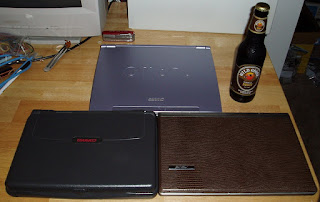
I also fully realize that not everyone is a computer enthusiast of the same 7th dan that I am. I always expect to have specialized machines around to do whatever nefarious bidding I require and use specialization as a reason (excuse if you prefer) to have a bunch of machines around. So with that as a setup, I have to say that I vastly prefer small laptops. Or notebooks. Some people prefer "notebooks". Feel free to do the appropriate mental substitution. There's just something magnificent about a machine that you can take with you.
Aeronauts, Unite!
One Andy Carra is particularly more responsible for my views on laptops than most. He introduced me to this machine. Yeah, I know that it's far more en vogue to use a pop can for scale but, I, um, didn't have one. Luckily, MacGuyver isn't my patron saint for nothin'.
This was before I really understood hardware or how to make it go. The Compaq Contura Aero is a 486sx 33MHz with a base 4MB of memory expandable to 20MB (max). It came with a 170MB or so hard drive, a proprietary PCMCI floppy drive, and a 7.8" 640x480 16 color passive display LCD. It weighs in at about 4 pounds with a footprint of 10.25" x 7.5" x 1.5". It's a thing of beauty.
It's surprisingly solid for such a small machine with a plastic shell. The trackball is tiny but still manages to be usable. The screen is compact but still readable. It has no internal fan so it's completely silent beyond the hard drive and the clicking of the keys. When you use it for a while and it starts to get warm, it has a very distinct odor--not an unpleasant one, but also not one that you'd expect to come from a computer. Most of the other Compaqs that I've encountered over the years have been junk, so I usually refer to the Aero as the "Greatest of the Compaqs". I don't think you can sum up in words what all makes the Aero cool, but if you sit down to use one, you know right away that it's a quality machine.
I bought one and modded it. It should be noted that the guts of the Aero were never intended to be mucked with by mere mortals. At some point I broke the infamous right hinge. For a short while anyway, I held the record for the biggest hard drive ever put into the tiny Aero (6GB circa about Y2K). I can't be mad at the guy who beat my "record" since he put up a kick-ass site about the Aero.
I still have this machine and it still works. It currently dual boots Win95 OSR2 and OpenBSD 2.8 (I think). Watch this space! for future hackeries with this, one of my favoritest machines.
Dark Sony Days
My first laptop was a godawfully heavy 13.3" Toshiba Satellite which I bought in grad school. It was (roughly) 12 pounds which doens't sound heavy unless you need to carry it around all day and with textbooks. With the right clutch of my Aero out and sans a battery that could run it for more than 15 minutes, I really really wanted another machine that I could take with me. At the time, and I did my homework for this one, the Thinkpads and the Vaios were the big names in subnotebooks. I bought a Vaio and it served me well. Specifically, a PCG R505DL boasting an at the time impressive 1GHz P3, 30GB hard drive, and 384MB of main memory. It's got a 12.1" 1024x768 passive display and sans docking station, weighs in at roughly 3 pounds.
This Vaio is a lot larger than the Aero but at the time, I don't think that Sony sold a smaller one (10" screen) with the appropriate power for a reasonable sum. It's a very full featured machine with a single PCMCIA slot, a DVD/CDRW, a floppy drive, built in Ethernet, a couple USB ports, and a Sony memory stick slot that I've used exactly twice in seven years. The dock and battery can be hotswapped in Windows if you're so inclined.
For as sleek and thin as the machine is, it's amazingly solid. The corners don't give, and you don't have to baby it to move it around. The base with all its ports is nice for folks who want to leave the optional bits hooked up to a workstation and take the machine for strolls. The base itself isn't terribly heavy so if you want to take the entire thing on a trip, it's not a big deal. The keyboard is compact but not too tiny to type on effectively and has a really nice feel. As an interesting data point to that effect, I think I've written more code on my Vaio than on any other machine I've ever owned including two engines and probabaly seven games/prototypes/tech demos.
It's a good machine, and I'm a little sad to be retiring it. Except that it means I have a new machine.
Humanizing Technology
With the sale of my house in Wisconsin, and a burning desire to buy something cool, I bought one of these. It's 10.6" x 7.5" x 0.9" with an 11.1" 1366x768 display and weighs in at less than 4 pounds. It's a low voltage core 2 duo and currently has 1GB of ram and a 120GB hard drive. The memory upgrade is already on the way though I suspect it'll be a while before I try to replace the drive (solid state drives need to come down in price a bunch).
Now, I'll be the first one to say that I was skeptical about the leather binding thing as well as Asus' current marketing campaign, but I have to say that the S6Fm is a high quality machine and it really wouldn't seem as cool without it. They really went out of their way to make it exceptional and that's something I can definitely appreciate.
Given that there are exactly two machines that fit my specifications available right now, I think I made the right choice. I thought that the price was high until I received it and found that with the machine I also got:
- a high capacity battery in addition to the normal one
- a matching optical mouse
- a mess of accessories which are by no means necessary, but definitely very thoughtful of them to have included
It's light, solid, and reasonably powerful for its size. Everything is built in and modern. I've got very few complaints. Course, I did just buy it and I haven't really had a lot of time to get used to it either, but I'm happy to have found an appropriate spiritual successor to my beloved Aero.
2007/07/26
Hack: Impossible?
[insert theme music here]
Your mission, should you choose to accept it, is to hack the following upgrade card into a workable machine sizing less than a breadbox and drawing under 50 watts of power at idle. Said machine should be capable of running OpenBSD 4.1 as a server or WinXP.
The target: one Powerleap upgrade card. Model: PL-Renaissance/R370S fitted with a 256MB stick of PC-133 SDRAM and an Intel 733MHz Pentium III Coppermine processor.

You have as much time as you need and a budget of $200. Beyond that, you may scrounge for parts around your workshop.
Good luck.
Your mission, should you choose to accept it, is to hack the following upgrade card into a workable machine sizing less than a breadbox and drawing under 50 watts of power at idle. Said machine should be capable of running OpenBSD 4.1 as a server or WinXP.
The target: one Powerleap upgrade card. Model: PL-Renaissance/R370S fitted with a 256MB stick of PC-133 SDRAM and an Intel 733MHz Pentium III Coppermine processor.
You have as much time as you need and a budget of $200. Beyond that, you may scrounge for parts around your workshop.
Good luck.
2007/07/17
Old Hardware
Most of the people who read here know me well enough that this isn't a surprise, but for everyone else out there: I have a problem with obsolete computer hardware.
The problem is that I seem to accumulate it at an alarming rate (i.e., greater than zero) and have a real hard time getting rid of it. Currently I own seventeen machines in various states of disrepair. The vast majority of those are functioning but without a real purpose. I never take a machine that I don't intend to use for some purpose of varying nefariousness and while I did use most of them, most of those uses are no longer necessary. That makes me sad, not in the least because I get bitten by the "must have new hardware" bug about every four months.
I don't think there's anything that depreciates in value quite like computer hardware except maybe automobiles and my stock options. Computer equipment just doesn't die that often if you take care of it. Oh sure, you'll have a hard drive or two die but for most parts just don't stop doin' they thang. Some of my (vast) collection I still have uses for but that leaves about a dozen machines I need to offload.
This is where y'all come in. I need help getting rid of these but I'm particular about where they should go. I don't want them in a landfill; I want them in the hands of someone who will put them to use doing whatever or at the very least recycled. So if you know of a good or even slightly disfunctional home that could use an old machine or three, drop me a line.
The problem is that I seem to accumulate it at an alarming rate (i.e., greater than zero) and have a real hard time getting rid of it. Currently I own seventeen machines in various states of disrepair. The vast majority of those are functioning but without a real purpose. I never take a machine that I don't intend to use for some purpose of varying nefariousness and while I did use most of them, most of those uses are no longer necessary. That makes me sad, not in the least because I get bitten by the "must have new hardware" bug about every four months.
I don't think there's anything that depreciates in value quite like computer hardware except maybe automobiles and my stock options. Computer equipment just doesn't die that often if you take care of it. Oh sure, you'll have a hard drive or two die but for most parts just don't stop doin' they thang. Some of my (vast) collection I still have uses for but that leaves about a dozen machines I need to offload.
This is where y'all come in. I need help getting rid of these but I'm particular about where they should go. I don't want them in a landfill; I want them in the hands of someone who will put them to use doing whatever or at the very least recycled. So if you know of a good or even slightly disfunctional home that could use an old machine or three, drop me a line.
2007/04/29
Hazards of the Infrequent
A long (long) time ago, I did 3D modelling. It was a long forgotten day when my 386 with its 16MB of system memory and 4.2GB of disk was a serious amount of computing power.

By today's standards it's pretty weak, but in a day when hardware acceleration hadn't quite reached consumers it was pretty awesome.
Hazard: I have these stored in RD4 format (I upgraded). Nothing in the modern era seems to be able read these files. God knows that even if I had an install disk for the program that made those that it'd be a miracle to get a machine together that will even run it.
The good news: the files are in ASCII. The bad news: the format was written by a "real programmer" and is unintelligible. Yeah. Awesome.
Sooo....my options are looking like:
fiddle through the data to try to piece together the geometry
keep looking for something that can import them
rebuild the models from the source sketches assuming I can find them
Woo.

By today's standards it's pretty weak, but in a day when hardware acceleration hadn't quite reached consumers it was pretty awesome.
Hazard: I have these stored in RD4 format (I upgraded). Nothing in the modern era seems to be able read these files. God knows that even if I had an install disk for the program that made those that it'd be a miracle to get a machine together that will even run it.
The good news: the files are in ASCII. The bad news: the format was written by a "real programmer" and is unintelligible. Yeah. Awesome.
Sooo....my options are looking like:
Woo.
2006/11/12
Broken Tools Redux
So...
I'm not a fan of Visual Studio 2005 by any means. Before I started this recent round of home programming, I had about a week when I thought that maybe just maybe I should finally upgrade past VC6. So amongst other options, I downloaded VC2K5 Express, the C++ version and was almost instantly disappointed. It doesn't do plugins. It doesn't do source control integration. I'm pretty attached to VisualAssist and no plugins kind of kills that, but no source control is where I draw the goddamn line. I realize that VC2K5 is free but come ON. No source control? So that was pretty much the end of that.
Fast forward to today, now about 2.5 months later...
I'm trying to do some sound stuff. I have the DX9 SDK installed. All of its samples have 2K3 and 2K5 solutions and not a dsw in sight. "Aha!" I say. "I've got 2K5 Express installed! I knew I didn't uninstall that crap for a reason!" Yeah. As it turns out, the express edition also doesn't come default with some important headers that you just might need like, say, <windows.h>. I'm dumbfounded even more than I was.
As it turns out, I totally missed the part in the installation instructions to install the Platform SDK. I dunno how I managed that but hey, I'm not good at following instructions. They even have a page with instructions on how to do this but it does involve hacking up files in the Express install. No clue why they don't install the basic stuff with it but then again I may be insane and the cab download is 400 megs.
Don't want to burn a disc (my burners are flaky) so I download the 17 cab files conveniently in 25 meg chunks and then the extractor which doesn't work. You need to give it a parameter which the extractor doesn't have, oh, and you have to rename it if you want to run it from the command line because it's got a - in it which isn't kosher. And forget trying to put it on your desktop--the extractor can't handle spaces (thank god it spews paths so I could find the extracted installer). And insult to injury: the 2K5 solutions for the samples I was trying to compile were missing libraries.
As it turned out, it took longer to make my dev environment do what I need than it was to write the code to load WAVs and play sounds.
I'm not a fan of Visual Studio 2005 by any means. Before I started this recent round of home programming, I had about a week when I thought that maybe just maybe I should finally upgrade past VC6. So amongst other options, I downloaded VC2K5 Express, the C++ version and was almost instantly disappointed. It doesn't do plugins. It doesn't do source control integration. I'm pretty attached to VisualAssist and no plugins kind of kills that, but no source control is where I draw the goddamn line. I realize that VC2K5 is free but come ON. No source control? So that was pretty much the end of that.
Fast forward to today, now about 2.5 months later...
I'm trying to do some sound stuff. I have the DX9 SDK installed. All of its samples have 2K3 and 2K5 solutions and not a dsw in sight. "Aha!" I say. "I've got 2K5 Express installed! I knew I didn't uninstall that crap for a reason!" Yeah. As it turns out, the express edition also doesn't come default with some important headers that you just might need like, say, <windows.h>. I'm dumbfounded even more than I was.
As it turns out, I totally missed the part in the installation instructions to install the Platform SDK. I dunno how I managed that but hey, I'm not good at following instructions. They even have a page with instructions on how to do this but it does involve hacking up files in the Express install. No clue why they don't install the basic stuff with it but then again I may be insane and the cab download is 400 megs.
Don't want to burn a disc (my burners are flaky) so I download the 17 cab files conveniently in 25 meg chunks and then the extractor which doesn't work. You need to give it a parameter which the extractor doesn't have, oh, and you have to rename it if you want to run it from the command line because it's got a - in it which isn't kosher. And forget trying to put it on your desktop--the extractor can't handle spaces (thank god it spews paths so I could find the extracted installer). And insult to injury: the 2K5 solutions for the samples I was trying to compile were missing libraries.
As it turned out, it took longer to make my dev environment do what I need than it was to write the code to load WAVs and play sounds.
2006/11/09
Broken Tools
Nothin' in the world like a good rant...or a bad one. If you're squeamish, you might want to look away.
To go with the 360 we use VS2K5 as is required by Microsoft. Since then I've noticed the following things that are broken which annoy the bejeezus out of me:
Bookmarks will sometimes persist even when I remove them even through reloads/reboots, often in completely incorrect places.
Go To Definition often does not function properly. Going to the declaration of the pure virtual method is not what I want! It used to give a list to resolve ambiguities; I'm not sure why that's not proper now.
It will randomly reset all my keyboard settings. I'm very particular about these and rather than reset them (sometimes every 10 minutes) I've accepted the loss in productivity vs. using the annoyingly user-hostile keyboard configuration dialogs to reset them yet again. The annoyance is especially apparent when I go home and work there where VC6 suffers no such issues!
It will randomly reset my toolbars. This would not be such a problem if my custom one was saved. I gladly heralded the return of the Pop Context widget but I end up having to hunt for it in the mess of other widgets to rebuild that toolbar on a semi-weekly basis.
Breakpoints will often be randomly added, sometimes in illegal places. I can't get these to go away except by removing all breakpoints in the project--some of which I actually need. Merely disabling them does not work reliably. This is especially irritating when it halts program execution or crashes because the bookmark is in a Bad Place (TM).
If I ever stop compilation to fix an error (can't save a file in the project during compilation and our project can take up to 10 minutes) I have to do a full build--it will corrupt the intermediate build files in non-obvious ways and I'll end up trying to track down an obscure bug that doesn't really exist.
I have a dual head system at work and I put some of my windows on a different monitor. The program will sometimes randomly move those windows around between runs, between starts, and sometimes even when I get back to work in the morning. I spend a ridiculous amount of time re-positioning and re-adding tabs.
It is extremely unstable. It will often take 10-30 minutes to crash even if I kill it from the task manager. My days tend to not be productive anyway because of poor workflow and environmental concerns but this is clearly not helping.
Some of these may have solutions but I sure as all hell can't find them (and yes, I've looked quite extensively). The IDE is a tool that I rely on to do my job. Developers tend to be NOT HAPPY when it doesn't work a lot of the time.
Along the same lines, we recently upgraded to IE7 for security reasons. IE7 is far less mission critical for what I do but still has the annoying habit of completely losing some of my bookmarks! They're not 100% lost--oh no, that would be far too easy. They're still there in my favorites list with the correct name and everything. They just have completely lost the URL they were charged with safeguarding.
I've got dozens of places that I go to look for stuff and I often can't remember all the URLs--I'm old, it happens. If only we had the tools and technology to keep a proper list of URLs inside our browsers!
To go with the 360 we use VS2K5 as is required by Microsoft. Since then I've noticed the following things that are broken which annoy the bejeezus out of me:
Some of these may have solutions but I sure as all hell can't find them (and yes, I've looked quite extensively). The IDE is a tool that I rely on to do my job. Developers tend to be NOT HAPPY when it doesn't work a lot of the time.
Along the same lines, we recently upgraded to IE7 for security reasons. IE7 is far less mission critical for what I do but still has the annoying habit of completely losing some of my bookmarks! They're not 100% lost--oh no, that would be far too easy. They're still there in my favorites list with the correct name and everything. They just have completely lost the URL they were charged with safeguarding.
I've got dozens of places that I go to look for stuff and I often can't remember all the URLs--I'm old, it happens. If only we had the tools and technology to keep a proper list of URLs inside our browsers!
2006/10/21
Memory Escapes Me
I've spent a day coming up with ideas to jot down here and yet right now none of them come to mind. Addled though it might be, this happens to be the only mind I'm currently in posession of (though I do change it from time to time).
And in an attempt to create the worst segue evar: this evening I've watched three extremely fascinating programs on the brain, the most interesting, about Savant Syndrome and the real life inspiration for Rainman Kim Peek. This, sadly, resulted in the completion of only one of my four tasks for the day but that's just one of the many costs of having too eager a curiosity.
In one of these programs, one particularly clever researcher had a nifty tool that would send crazy magnetic something or others through the subject's head and scramble their noggin to try to recreate some of what some savants' brains do with some very encouraging results. And no, that last sentence wasn't run-on. Assuming there are no long-ranging health problems and the ever-advancing march of technology and our own understanding of the brain continues, this raises some very interesting ethical questions. "Who will be allowed to use the happy brain device?"
I expect that within my lifetime that we'll be bombarded with many of these which I suspect we may be ill-prepared to deal with. As science procedes, one can only hope that society will also proced, preferrably at an accelerated pace, in order that such questions be answered satisfactorily.
And in an attempt to create the worst segue evar: this evening I've watched three extremely fascinating programs on the brain, the most interesting, about Savant Syndrome and the real life inspiration for Rainman Kim Peek. This, sadly, resulted in the completion of only one of my four tasks for the day but that's just one of the many costs of having too eager a curiosity.
In one of these programs, one particularly clever researcher had a nifty tool that would send crazy magnetic something or others through the subject's head and scramble their noggin to try to recreate some of what some savants' brains do with some very encouraging results. And no, that last sentence wasn't run-on. Assuming there are no long-ranging health problems and the ever-advancing march of technology and our own understanding of the brain continues, this raises some very interesting ethical questions. "Who will be allowed to use the happy brain device?"
I expect that within my lifetime that we'll be bombarded with many of these which I suspect we may be ill-prepared to deal with. As science procedes, one can only hope that society will also proced, preferrably at an accelerated pace, in order that such questions be answered satisfactorily.
Subscribe to:
Posts (Atom)
