2011/11/19

2011/10/02
Programmer Art

Original resolution was something like 1500x3600 done almost entirely in ArtRage. This is the only reasonable piece I've done since...er...last March.
2011/08/07
BrickFair 2011

BrickFair 2011 is officially over. This time I knew what I was getting myself into and went in better prepared. For those who don't frequent my flickr stream, I completed SHIP #4 in July, the Jaguar-class BCL. She was built in about 300 hours over the course of about two months topping the scales at around 40 pounds and ~8,000 pieces. The ship deconstructs into about 100 large-ish pieces that all fit into the nice car which sadly I didn't end up taking. Five hours of reconstruction on site and she was ready for show. I also took four fighters: two of these guys and one each of these.
And what a show it was! It amazes me that Lego people are so goshdarned awesome, pretty much as a rule. I got to catch up with some old pals and got to meet some awesome new ones (do follow the links--those guys do amazing work). It was good times dampened only by being pretty hung-over from a bottle of expensive scotch that I shouldn't have bought. To top it all off, the Jag took the award for "Best in Space" which is both awesome and unexpected. I'm already thinking of all the fun-cool-sweet stuff that I want to build now that the event is winding down. Scheduling gods willing, I'll be back next year in good form.
2011/05/30
Rift: The Bad
No game is without its flaws, and Rift is no different. As always, your mileage may vary.
Steep Learning Curve
Most games of this type suffer from this kind of thing mostly because they are fairly complex. That's to be somewhat expected. The Ascended system takes this the next logical step. In other games you choose your class, maybe bits of your spec, and you're on your way. At the very beginning of Rift you pick your first soul. You've already picked a class and now there's more to choose? Worse yet, you're picking from a largish list with only the barest of information.
One of the strengths of the game is its customizabiliy so it's hard for me to single it out in this installment. On the other hand, it is tremendously confusing for anyone who a) isn't hardcore, and b) hasn't done a mess of research about the game before hand, and c) has played other games in the genre I got this stuff all sorted in beta but as part of the head start program, a very large number of the people in my guild had not. These are some of the frequently asked questions:
Misconceptions From Other Games
A better segue, I could not conceive. What makes the Ascended system hard to get your head around is the fact that it's not really at all like other games. When you get it all out on the page it's pretty obvious that the devs put some serious thought into not make any given decision painful. This is not helped by other games in the genre.
For those of you who don't remember the Bad Old Days(TM), let's take a trip down memory lane. Your class defined/defines everything you can do. If you're a cleric, you heal and not much else. If you wear plate, you tank and not much else. If you can stealth, you DPS but only if no one is hurting you, yadda, yadda, yadda. We all know the score. If you could spec (and in a lot of games you couldn't) you were lucky if you could respec--ever, and sometimes it required the killing of a dragon.
As mentioned in the previous post, lots of builds shatter the usual holy trinity's usual cast of characters. To make matters worse, you can swap it between combats if you so choose! Unlike in other games where there was a pretty clear cut best choice, Rift allows you supreme flexibility and I like that. Unfortunately there are a (very) large number of people who a) don't get it, b) don't want to get it, and c) try to impose their Right Way(TM) onto the other players in the game. Just as the community often made Champions Online bad, the same is also true for Rift, just not to such an extreme level.
Limited Appearance Customization
Most games in the genre have very, very complicated and adjustable faces and/or costumes. There are usually lots of options and lots of ways to build exactly the face you want, given the time and the inclination. A lot of times this also means that you can create some terribly horrific looking characters but all in all you don't spend a lot of time looking at your own character's face anyway.
Rift streamlines this tremendously. Each {race, gender} pair has a single face with a very limited number of different features to adjust. The face slider is a triangle with big chunky types at the left, thin types at the right, and square-jawed types at the bottom. The game lets you pick anything within the continuum and does the appropriate blending in game. The upshot is that it's very hard to get a character that doesn't look right which I like. The downside is that it's not uncommon to walk around in the main cities and see many of your identical twins. I don't like that.
But it gets worse! A lot of the gear in the game shares the same art assets. This is to be expected. One of the bigger problems is that a lot of the top end gear is identaical but the lower level ones aren't. In a game where you want top end gear to be aspirational, it's almost criminal for the art between epic tiers to be the same. Say what you want about the art style but this part isn't so good.
Raid Timers on Expert Dungeons
Expert dungeons are what you might expect: everything cranked up to 11 in the instances you've already done. The old bosses have new tricks and there are new bosses to learn. This is all well and good. The difficulty curve is relatively easily overcome for competent players. Personally, I liked the increased difficulty even if it led to some nail-biting and grey hairs.
The bad part is that progression is very much gated on completing expert dungeons so that you can either get the rare dropped upgrade or enough plaques to buy gear but there are one day lockouts on expert dungeons. Why? The drops in the expert dungeons aren't spectacular on the whole and until recently you could clear an entire instance and get only blue non-upgrades. With daily quests givingmost all of the plaque rewards there's even less incentive to run them over and over again for a given group. Worse yet, if your group of friends is oddly sized or isn't immaculately balanced in terms of roles, you can't run it twice to get everyone the rewards. That stinks.
If a group goes into a 5-person dungeon and farms the first boss to get X to drop, who really cares? Was there really a need to make people wait around a day to try again? These are not raids! The upgrades are good but not stellar. Did there really need to be a lockout? Sure, you can PUG them, but who wants to do that? This leads us to...
Lack of Medium Sized Group Content
There is a big difference between doing one group content and raid content. This is usually in the form of logistics like getting people geared, in the right place, and generally going in the same direction. It sounds easy but it's not (trust me). In the best case there's a reasonable stepped progression that makes the bigger things seem more accessible.
Vanilla WoW had a real tough time with this requiring maybe 15 people for an UBRS run and a pretty solid 40 for a serious Molten Core run. This progression was then fixed (much to my benefit) by adding the Zul'Gurub and Ahn'Qiraj 20 person raids. That meant a much easier progression with the added benefit that raids usually had better gear moving to the next tier. Rift until recently, did not have that. Prior to launch Trion said that they had 10 and 20 person versions of all the raids so that if you were in a smallish guild or more casual one that you still had fun things to do. There were also supposed to be 10 person raid rifts that were appropriately tuned to people not geared for the big raids. Both of these were cut prior to release. At the time of this writing, the game has been out for just over 3 months and they're just now adding the 10 person content. This probably doesn't seem bad until you consider that I hit cap in two weeks and I work full time.
There have been lots of people in small or casual guilds that have already done all of the appropriate 5-person content and have nowhere to go. Because it doesn't take all that long to hit 50 there isn't as much investment in your characters and thus far less reason to stick around to try to get into the big raids. Sure, you can do the small number of expert rifts in a raid and get one or two reasonable drops but right now it takes five clears of T1 instances to be able to open one. It takes ten clears of T2 instances to open a raid rift and you'd better be well geared to have a hope of completing one. Remember: you can't run more people through easy experts because of the lockouts so if you're short a healer or tank and/or for whatever reason can't form regular groups, you're kind of out of luck.
As mentioned earlier, the last patch addresses some of these issues. There are new 10 person raids. There are also new crafting rifts and they've made expert and raid rifts easier to open. It looks like there's hope yet, but it remains to be seen if this is enough or if lasting damage has already been done to the playerbase.
The Grind
Rift is an easy game to level in. I kind of wish it wasn't. When you get to 50 and aren't in a raiding guild (as in: most people) you thankfully aren't excluded from gear progression. The bad part is that gear progression comes in the form of a particularly ugly grind. If you're like me, you want to see everything so you go through all of the appropriate dungeons more or less at the appropriate levels. Maybe you run them twice. But now you hit cap and want to progress and you go back to those same dungeons on expert mode.
The problem lies first with the itemization which is largely lacking for many roles, and next in the fact that you mostly get upgrades through items bought with plaques. Drop rate for epics in the expert dungeons (read: meaningful upgrades) is not especially high which means that you mostly need to complete runs to gather enough plaques to buy gear. On the surface, buying gear from plaques earned by killing bosses/finishing quests seems like a good idea. You do X runs, you buy Y gear at a fixed rate. The problem is that they haven't settled on what a good rate is, yet. Without belaboring the point, it's been changed a handful of times since release and at every change it gets slower. This seems bad.
It looks a lot like a dev team that's struggling to slow down turnover, but this isn't a great way to do it. At some point you've seen all the dungeons and have been unlucky enough with drops that you look at the tiny number of plaques you have and the number of plaques you still need and come to the conclusion that it just isn't worth it anymore. No one wants a grind and as cool as the instances are the first handful of times, if you go through the same ones for weeks on end, they lose their luster very quickly. But what else is there to do?
Steep Learning Curve
Most games of this type suffer from this kind of thing mostly because they are fairly complex. That's to be somewhat expected. The Ascended system takes this the next logical step. In other games you choose your class, maybe bits of your spec, and you're on your way. At the very beginning of Rift you pick your first soul. You've already picked a class and now there's more to choose? Worse yet, you're picking from a largish list with only the barest of information.
One of the strengths of the game is its customizabiliy so it's hard for me to single it out in this installment. On the other hand, it is tremendously confusing for anyone who a) isn't hardcore, and b) hasn't done a mess of research about the game before hand, and c) has played other games in the genre I got this stuff all sorted in beta but as part of the head start program, a very large number of the people in my guild had not. These are some of the frequently asked questions:
- Q: Am I stuck with the souls I picked? A: no, you can pick up all the souls at level 13 through quests.
- Q: How many points do I get to spend in my spec? A: 66 at level 50; you get one per level and two for every level that's an even multiple of 3.
- Q: How do I get new abilities? A: most of the time you get them automagically by spending points in a spec tree (in the root, unlocked by total point count). Sometimes you can pick them directly in the spec.
- Q: Can I respec? A: yes, at the trainer and it's not terribly expensive.
- Q: What is a role and why do I care? A: a role is a slot for a single spec. You can have up to [s]four[/s] five of these so that you can change your character for any particular encounter.
Misconceptions From Other Games
A better segue, I could not conceive. What makes the Ascended system hard to get your head around is the fact that it's not really at all like other games. When you get it all out on the page it's pretty obvious that the devs put some serious thought into not make any given decision painful. This is not helped by other games in the genre.
For those of you who don't remember the Bad Old Days(TM), let's take a trip down memory lane. Your class defined/defines everything you can do. If you're a cleric, you heal and not much else. If you wear plate, you tank and not much else. If you can stealth, you DPS but only if no one is hurting you, yadda, yadda, yadda. We all know the score. If you could spec (and in a lot of games you couldn't) you were lucky if you could respec--ever, and sometimes it required the killing of a dragon.
As mentioned in the previous post, lots of builds shatter the usual holy trinity's usual cast of characters. To make matters worse, you can swap it between combats if you so choose! Unlike in other games where there was a pretty clear cut best choice, Rift allows you supreme flexibility and I like that. Unfortunately there are a (very) large number of people who a) don't get it, b) don't want to get it, and c) try to impose their Right Way(TM) onto the other players in the game. Just as the community often made Champions Online bad, the same is also true for Rift, just not to such an extreme level.
Limited Appearance Customization
Most games in the genre have very, very complicated and adjustable faces and/or costumes. There are usually lots of options and lots of ways to build exactly the face you want, given the time and the inclination. A lot of times this also means that you can create some terribly horrific looking characters but all in all you don't spend a lot of time looking at your own character's face anyway.
Rift streamlines this tremendously. Each {race, gender} pair has a single face with a very limited number of different features to adjust. The face slider is a triangle with big chunky types at the left, thin types at the right, and square-jawed types at the bottom. The game lets you pick anything within the continuum and does the appropriate blending in game. The upshot is that it's very hard to get a character that doesn't look right which I like. The downside is that it's not uncommon to walk around in the main cities and see many of your identical twins. I don't like that.
But it gets worse! A lot of the gear in the game shares the same art assets. This is to be expected. One of the bigger problems is that a lot of the top end gear is identaical but the lower level ones aren't. In a game where you want top end gear to be aspirational, it's almost criminal for the art between epic tiers to be the same. Say what you want about the art style but this part isn't so good.
Raid Timers on Expert Dungeons
Expert dungeons are what you might expect: everything cranked up to 11 in the instances you've already done. The old bosses have new tricks and there are new bosses to learn. This is all well and good. The difficulty curve is relatively easily overcome for competent players. Personally, I liked the increased difficulty even if it led to some nail-biting and grey hairs.
The bad part is that progression is very much gated on completing expert dungeons so that you can either get the rare dropped upgrade or enough plaques to buy gear but there are one day lockouts on expert dungeons. Why? The drops in the expert dungeons aren't spectacular on the whole and until recently you could clear an entire instance and get only blue non-upgrades. With daily quests giving
If a group goes into a 5-person dungeon and farms the first boss to get X to drop, who really cares? Was there really a need to make people wait around a day to try again? These are not raids! The upgrades are good but not stellar. Did there really need to be a lockout? Sure, you can PUG them, but who wants to do that? This leads us to...
Lack of Medium Sized Group Content
There is a big difference between doing one group content and raid content. This is usually in the form of logistics like getting people geared, in the right place, and generally going in the same direction. It sounds easy but it's not (trust me). In the best case there's a reasonable stepped progression that makes the bigger things seem more accessible.
Vanilla WoW had a real tough time with this requiring maybe 15 people for an UBRS run and a pretty solid 40 for a serious Molten Core run. This progression was then fixed (much to my benefit) by adding the Zul'Gurub and Ahn'Qiraj 20 person raids. That meant a much easier progression with the added benefit that raids usually had better gear moving to the next tier. Rift until recently, did not have that. Prior to launch Trion said that they had 10 and 20 person versions of all the raids so that if you were in a smallish guild or more casual one that you still had fun things to do. There were also supposed to be 10 person raid rifts that were appropriately tuned to people not geared for the big raids. Both of these were cut prior to release. At the time of this writing, the game has been out for just over 3 months and they're just now adding the 10 person content. This probably doesn't seem bad until you consider that I hit cap in two weeks and I work full time.
There have been lots of people in small or casual guilds that have already done all of the appropriate 5-person content and have nowhere to go. Because it doesn't take all that long to hit 50 there isn't as much investment in your characters and thus far less reason to stick around to try to get into the big raids. Sure, you can do the small number of expert rifts in a raid and get one or two reasonable drops but right now it takes five clears of T1 instances to be able to open one. It takes ten clears of T2 instances to open a raid rift and you'd better be well geared to have a hope of completing one. Remember: you can't run more people through easy experts because of the lockouts so if you're short a healer or tank and/or for whatever reason can't form regular groups, you're kind of out of luck.
As mentioned earlier, the last patch addresses some of these issues. There are new 10 person raids. There are also new crafting rifts and they've made expert and raid rifts easier to open. It looks like there's hope yet, but it remains to be seen if this is enough or if lasting damage has already been done to the playerbase.
The Grind
Rift is an easy game to level in. I kind of wish it wasn't. When you get to 50 and aren't in a raiding guild (as in: most people) you thankfully aren't excluded from gear progression. The bad part is that gear progression comes in the form of a particularly ugly grind. If you're like me, you want to see everything so you go through all of the appropriate dungeons more or less at the appropriate levels. Maybe you run them twice. But now you hit cap and want to progress and you go back to those same dungeons on expert mode.
The problem lies first with the itemization which is largely lacking for many roles, and next in the fact that you mostly get upgrades through items bought with plaques. Drop rate for epics in the expert dungeons (read: meaningful upgrades) is not especially high which means that you mostly need to complete runs to gather enough plaques to buy gear. On the surface, buying gear from plaques earned by killing bosses/finishing quests seems like a good idea. You do X runs, you buy Y gear at a fixed rate. The problem is that they haven't settled on what a good rate is, yet. Without belaboring the point, it's been changed a handful of times since release and at every change it gets slower. This seems bad.
It looks a lot like a dev team that's struggling to slow down turnover, but this isn't a great way to do it. At some point you've seen all the dungeons and have been unlucky enough with drops that you look at the tiny number of plaques you have and the number of plaques you still need and come to the conclusion that it just isn't worth it anymore. No one wants a grind and as cool as the instances are the first handful of times, if you go through the same ones for weeks on end, they lose their luster very quickly. But what else is there to do?
2011/04/29
Rift: The Good
Most of you probably know that I've been playing Rift since beta. Since my time is most likely drawing to a close there, I thought I'd give it the usual treatment. It is the kind of MMO that I tend to like: deep, complex, and the kind of game where player skill is important and immediately apparent. There's a lot to like which I'll sum up here in the usual no-particular-order.
Well Realized World
The world as a whole is consistent both in art and in storytelling for the most part. The settings are all fairly distinct though perhaps not as memorable as, say, Snake Gulch, but really. Each zone has its own theme and a story line of varying quality weaving through the quest chains that more people would enjoy if they could be bothered to read. The instances are also themed and woven fairly interestingly in with the plot of the rest of the world. The end result is quite good if you're into that kind of thing which I realize most people aren't.
The Ascended Class System
The mile high view of the class system goes a little something like this: you pick one of four classes and then three of a bunch of souls which determines what your character can do. Each soul is themed (offense, defense, heals, utility, etc.) and tailored per class. You get your typical one or two points per level and actively spend them to get the improvements you want but those points count two ways. First, you get the thing you're directly improving (reduce cast times, increase crit chances, get a new spell, etc). Second, you get points toward that tree which opens up a set of fixed powers (the "root" powers). So you can spend 10 points however you like within the framework and get the same root powers that everyone spending point in that soul gets. The upshot is that finding the best builds is a little trickier but that you're never really left with an unplayable build.
Putting builds together in interesting ways is the crux of this system. You can build offense powerhouses, rock-hard defensive masters, and jacks of all trades with a little effort. Mages and rogues can heal, clerics and rogues can tank, and warriors can be masterful damage dealers. But it's better than that, even. You can have up to four roles which you can use to house completely different builds. My main character is a cleric and I mainly tanked, but I can also DPS or heal with a pretty simple change of a role. If you like the meta game of creating effective builds, then you'll love Rift. Unfortunately, this also causes some issues which we'll discuss in the next installment.
Cutting Edge UI
As a former UI programmer, I know all too well that UI tends to fall into the bin labeled "under the radar unless it's crap" which usually means that if you get feedback for it at all, it's usually negative. Rift bucks this trend by doing exactly what WoW did: it took the best parts of contemporary games and added some bits that make it even better. There's a button that sells all the vendor trash from your inventory. There's a search for your backpack in case you can't find what you're looking for. There's a clickable icon in your on-screen quest tracker for items you need to use to advance a quest. It's not any one thing, but myriad small things tacked onto a UI that's both different and familiar that makes it great. It just plain makes the game better and I like that.
Many people criticize the UI as being "too WoW-like". Are they mad? Why wouldn't you steal the streamlined and polished UI from the industry leader from which some very large percentage of your user base comes from? I'm sorry, it's like a candy bar being too chocolatey--it just doesn't make sense! Conventions, whether we like where they came from or not, are just that. You expect them to be there and in the way you remember; changing them for spite's sake is not conducive to usability.
Invasion Events
One of Rift's better additions is that occasionally, based on population, rifts will open up periodically in the game world. These can have varied encounter mechanics usually culminating in a boss all defeatable in about ten minutes. If not closed, these rifts will periodically spawn an invasion squad that tromps through the world attacking players and NPCs it encounters on the way. If the population is high enough in an area, the game will start a major invasion in which piles of rifts will open up spawning yet more piles of invasion squads that usually takes over quest hubs and the like. Lose too many quest hubs and the invasion "succeeds" and the boss won't spawn typically leaving quest hubs in an unusable but reversible state. With a little bit of strategery, however, players can defend key points, drive back the invaders, and spawn a raid boss that tromps through the world wreaking havoc. Downing any of the invaders yields currencies that can be used to buy interesting gear and downing one of the raid bosses can be very lucrative.
You would think that having your quest hubs worked over by mobs would suck and it indeed can be unfortunate to log into the middle of a giant invasion. In practice however, it's quite fun and you can lose hours just flowing from rift to rift. Being OCD about playing these kinds of games, I leveled quickly and I was very saddened to not see an invasion once I'd passed the middle of the leveling curve.
Interesting Encounters
Back in the bad old days you had a tank, plopped them in front of a mob, stuck a healer behind with the "1" key weighted down and went to town. Sure, you needed a team of oxen to move the tank into place and you had to be mindful to punch at least one breathing hole into his helmet, but it was nonetheless pretty good. Then someone got the bright idea that what these encounters really needed was more dancing. It isn't difficult at all to imagine a malicious encounter designer belting off a proper evil laugh from the depths of a hollowed out volcano in expectation of thousands of players being manipulated as if by invisible designery strings.
Most of the encounter dances in Rift are of the form "don't stand in the fire" or "don't do X when Y is announced". Since most of this comes through clearly in the presentation often with AV accompaniment from the UI, the cues are fairly hard to miss. Then penalties for not doing the right thing in these events is usually pretty harsh and is sometimes "death" in a "do not pass go" kind of way. A lot of people dislike this, but I think it's fantastic. It means that you must be at least this competent to progress and it starts out in the very first instances. Player skill matters and in a game that you expect people to play a lot of, you need that kind of thing.
So it's all Good, Then?
Well...no. We'll discuss some of what they got wrong (and got really, really wrong) in the next installments.
Well Realized World
The world as a whole is consistent both in art and in storytelling for the most part. The settings are all fairly distinct though perhaps not as memorable as, say, Snake Gulch, but really. Each zone has its own theme and a story line of varying quality weaving through the quest chains that more people would enjoy if they could be bothered to read. The instances are also themed and woven fairly interestingly in with the plot of the rest of the world. The end result is quite good if you're into that kind of thing which I realize most people aren't.
The Ascended Class System
The mile high view of the class system goes a little something like this: you pick one of four classes and then three of a bunch of souls which determines what your character can do. Each soul is themed (offense, defense, heals, utility, etc.) and tailored per class. You get your typical one or two points per level and actively spend them to get the improvements you want but those points count two ways. First, you get the thing you're directly improving (reduce cast times, increase crit chances, get a new spell, etc). Second, you get points toward that tree which opens up a set of fixed powers (the "root" powers). So you can spend 10 points however you like within the framework and get the same root powers that everyone spending point in that soul gets. The upshot is that finding the best builds is a little trickier but that you're never really left with an unplayable build.
Putting builds together in interesting ways is the crux of this system. You can build offense powerhouses, rock-hard defensive masters, and jacks of all trades with a little effort. Mages and rogues can heal, clerics and rogues can tank, and warriors can be masterful damage dealers. But it's better than that, even. You can have up to four roles which you can use to house completely different builds. My main character is a cleric and I mainly tanked, but I can also DPS or heal with a pretty simple change of a role. If you like the meta game of creating effective builds, then you'll love Rift. Unfortunately, this also causes some issues which we'll discuss in the next installment.
Cutting Edge UI
As a former UI programmer, I know all too well that UI tends to fall into the bin labeled "under the radar unless it's crap" which usually means that if you get feedback for it at all, it's usually negative. Rift bucks this trend by doing exactly what WoW did: it took the best parts of contemporary games and added some bits that make it even better. There's a button that sells all the vendor trash from your inventory. There's a search for your backpack in case you can't find what you're looking for. There's a clickable icon in your on-screen quest tracker for items you need to use to advance a quest. It's not any one thing, but myriad small things tacked onto a UI that's both different and familiar that makes it great. It just plain makes the game better and I like that.
Many people criticize the UI as being "too WoW-like". Are they mad? Why wouldn't you steal the streamlined and polished UI from the industry leader from which some very large percentage of your user base comes from? I'm sorry, it's like a candy bar being too chocolatey--it just doesn't make sense! Conventions, whether we like where they came from or not, are just that. You expect them to be there and in the way you remember; changing them for spite's sake is not conducive to usability.
Invasion Events
One of Rift's better additions is that occasionally, based on population, rifts will open up periodically in the game world. These can have varied encounter mechanics usually culminating in a boss all defeatable in about ten minutes. If not closed, these rifts will periodically spawn an invasion squad that tromps through the world attacking players and NPCs it encounters on the way. If the population is high enough in an area, the game will start a major invasion in which piles of rifts will open up spawning yet more piles of invasion squads that usually takes over quest hubs and the like. Lose too many quest hubs and the invasion "succeeds" and the boss won't spawn typically leaving quest hubs in an unusable but reversible state. With a little bit of strategery, however, players can defend key points, drive back the invaders, and spawn a raid boss that tromps through the world wreaking havoc. Downing any of the invaders yields currencies that can be used to buy interesting gear and downing one of the raid bosses can be very lucrative.
You would think that having your quest hubs worked over by mobs would suck and it indeed can be unfortunate to log into the middle of a giant invasion. In practice however, it's quite fun and you can lose hours just flowing from rift to rift. Being OCD about playing these kinds of games, I leveled quickly and I was very saddened to not see an invasion once I'd passed the middle of the leveling curve.
Interesting Encounters
Back in the bad old days you had a tank, plopped them in front of a mob, stuck a healer behind with the "1" key weighted down and went to town. Sure, you needed a team of oxen to move the tank into place and you had to be mindful to punch at least one breathing hole into his helmet, but it was nonetheless pretty good. Then someone got the bright idea that what these encounters really needed was more dancing. It isn't difficult at all to imagine a malicious encounter designer belting off a proper evil laugh from the depths of a hollowed out volcano in expectation of thousands of players being manipulated as if by invisible designery strings.
Most of the encounter dances in Rift are of the form "don't stand in the fire" or "don't do X when Y is announced". Since most of this comes through clearly in the presentation often with AV accompaniment from the UI, the cues are fairly hard to miss. Then penalties for not doing the right thing in these events is usually pretty harsh and is sometimes "death" in a "do not pass go" kind of way. A lot of people dislike this, but I think it's fantastic. It means that you must be at least this competent to progress and it starts out in the very first instances. Player skill matters and in a game that you expect people to play a lot of, you need that kind of thing.
So it's all Good, Then?
Well...no. We'll discuss some of what they got wrong (and got really, really wrong) in the next installments.
2011/01/01
2010 in Review
In following last year's Award Winning post, this is 2010 in review. Probably the biggest change this year was officially getting back into Lego after something like 20 years of not doing much with it. This culminated in a trip to Brick Fair at which I won an award. The Lego action was, naturally, punctuated by a number of excellent beers and heavy drinking.
Massachusetts Can Bite Me
I wasn't really a fan of Virginia and I really hated Maryland, but Massachusetts is giving Maryland a real good run for its money. This place is way too goddamned expensive, and everyone here seems to be woefully self-absorbed. Given that my place of employ has moved much closer to Boston proper, I now have to take a much busier route to go to/from work and I'm convinced that my chances of dying in a traffic crash are now several hundred times higher. Note: they were not low before. People here really can't drive for shit; must be an east coast thing.
Probably the only redeeming factor of where I live is having three Lego stores within driving distance--assuming I don't die on the way there or back, mind you.
Fun With Lego
One of the side effects of not crunching like crazy is that I've had a lot more time to pursue different hobbies, the most time consuming of those (so far) is building with Lego again. If you haven't seen my flickr stream, you should go go there right now. It's OK, I'll wait. Unbeknownst to me (though I really should have figured) there's a huge online Lego builder community and I've been able to pick up a lot of fun techniques from them. It all came to a frothy head at Brick Fair in August. It was very cool and not just because I won a trophy. I'm hoping I can get back there next year and am in the very early stages of building a presentable piece. Wish me luck!
Gaming
Other than Lego (and drinking) I played a lot of games, some of which were very good. Most notably, I finally broke down and bought an Xbox360. This is largely because my PS3 was bricked by one of Sony's firmware flashes which killed the Blu-ray drive. I got the PS3 as a gift so I suppose I shouldn't be so pissy about the $150 they want to replace the drive, but it's the principle of the thing. Anyway...
Torchlight: ***
Recommended by a bunch of people so I picked it up. It's a very pretty Diablo-like hack&slash kind of game that looks a lot like World of Warcraft. This isn't a coincidence since it's a lot of the same developers. I sort of view it as a distraction--pretty with nice explosions but lacking any real depth.
Mass Effect 2: *****
Bioware seems to have fixed most of the major issues (stupid inventory system, maddening difficulty curve, etc.) but seem to have left some of the awesome on the cutting room floor. I was hoping to get through the game again now that I've picked up all the DLCs but dumping half a diet coke into the gaming rig kind of puts the skids on that. The short: some things streamlined very well, some things streamlined too much, and some pretty awful plot points. You can read all about it on them thare intarwebs so I won't rehash, though I'm hoping that ME3 strikes a happier balance.
Knights of the Old Republic: *****
OK, so Mass Effect is pretty awesome but it's the first of the Bioware games I'd played. Let's fix that! KoTOR was the next one and holy crap, I'm sad I missed this when it first came out. The graphics haven't aged well but the story holds up exceptionally. It's got some very memorable characters (HK-47, Mission Vao, Bastilla Shan) and probably the best plot twist in all of gaming. Definitely one of the best RPGs I've played.
Knights of the Old Republic 2: ***, **** w/mods
I mean, why not? Unbeknownst to me, Obsidian has quite the reputation for starting big but ending flat on their projects which is probably why I had such a hard time finding a copy. The beginning of the game is exceptional from the twisting plotlines to the character development. The ending of the game is a travesty where most of the interesting bits are dropped on the floor and the opportunity lost. Luckily, the fan community has come to the rescue with a number of mods that make the game seem a little more complete. I have to wonder how awesome the game would have been if it had been released in a more completed state.
Bioshock: ***
I'm late to the party as usual. It's a pretty good shooter with some interesting plot points, but overall I wasn't all that thrilled with it. There really needed to be more reason to use the other plasmids and I never had enough ammo. It was very pretty but it was also frustratingly dark a lot of the time. I'll probably grab the sequel at some point, but I'm not in any huge hurry. Interesting fourth wall busting.
Supreme Commander 2: ***
As much of a Supreme Commander fanboi as I might be, Supreme Commander 2 really didn't do it for me. It really lacked the depth of the first and the single player campaign had a very brittle twist. I played the campaign through, did a couple skirmishes, and really didn't give it more thought than that. Very sad-making
Vanguard: *****
Very few people played Vanguard at release. I caught it about six months in and it was already on its way out. This summer, my MMO "friends" decided to pick it back up again and I have to say that it's still all that and a bag of chips. On good hardware most of the perf bugs are gone and the game has been somewhat streamlined from the bad old days but it still has most of the depth it had the last time I played. Alas, it isn't really a solo game and since my "friends" stranded me there...again....it didn't make sense to keep the sub up. Vanguard is really the last of a dying breed: the involved MMO--the kind I really like. It's sad that there aren't more like it being made and even more sad that I can't find reliable people to play with. Vanguard remains the only MMO that I really want to play more of but can't. It remains one of the best MMOs that no one plays.
Civ V: ****
Terribly broken in a lot of ways, but still the same old Civ in others. I'm a little more forgiving than many due to having gotten an unexpected credit on it (I did work on it, just not for very long). I think the game is less strategically interesting than, say, Civ IV, but the tactical combat is a lot more interesting. I played a bunch of it, found the One True Path To Victory, and then promptly lost interest. I'm a little disappointed that it could bring my beefy gaming box (RIP) to its knees.
Halo: Reach: ***
This is actually what made me buy a 360, finally. I am an unabashed fan of the original Halo on the original Xbox. I played the crap out of it. Halo 2 was kind of a letdown--on top of being very short, it seemed to leave the story in a really crappy place. In the intervening, what, five years there's been a lot of Halo on systems I didn't have, so when the reviews of Reach started rolling in saying that it was a spiritual successor to the original, I had to pick it up. The good: pretty much just like the original Halo in regards to gameplay. The bad: pretty much just like the original Halo in regards to gameplay. The weapons feel "right" which is nice, but it has the typical trope of going through an area one direction and then back through the same area in the other direction at a later point. It also suffered from Halo's typical "there's way more going on than I get during the game" which kind of sucks. There's soooo much backstory that it's sad that they don't deem to show us more of it. Also, as a particular bad point, none of the other spartans on your team seem all that interesting--sort of cardboard cutouts that die one at a time to mark your progression through the game. Enjoyable, if dated, but it really left me wanting more.
Halo: ODST: ****
After Reach, I didn't really have high hopes for ODST which is probably why I liked it so much. It was short, like Reach, but had much better storytelling. The game is mostly character based with you picking up the roles of various people in your squad and it was fun to see part of how it tied into the events of Halo 3. I thought it was, anyway, until I played Halo 3 and saw how tangential it all was. So I suppose I like the tie-ins that I made up in my head rather than the ones that were actually in the game. Still, a very enjoyable playthrough, if a bit short.
Halo 3: ****
I really did play them in this order. It turned out to be pretty difficult to get Halo 3 which I didn't expect. I don't know if it's because I've been playing so many Bioware games or what, but I thought that the storytelling kind of fell flat in Halo 3. A lot of it seemed very sudden and most of the big events were all too predictable. I'm also kind of let down by the ending.
Red Faction: Guerilla: ****
This one is sort of a love/hate thing for me. On the one hand, this is the guy that bricked my PS3. On the other hand, having been lent it for the X360 and actually been able to play it, it's a really fun game. I don't know why it flew so low on the radar because it has a lot of really awesome things: fun driving, fun shooting, and being able to destroy just about anything in the world. Building in the way? No problem! In fact, the hardest part is deciding whether you want to run your vehicle through it, kill it with explosive charges, or (my personal favorite) go to town on it with your trusty sledge. Decisions, decisions!
So there you have it, 2010 in review.
Massachusetts Can Bite Me
I wasn't really a fan of Virginia and I really hated Maryland, but Massachusetts is giving Maryland a real good run for its money. This place is way too goddamned expensive, and everyone here seems to be woefully self-absorbed. Given that my place of employ has moved much closer to Boston proper, I now have to take a much busier route to go to/from work and I'm convinced that my chances of dying in a traffic crash are now several hundred times higher. Note: they were not low before. People here really can't drive for shit; must be an east coast thing.
Probably the only redeeming factor of where I live is having three Lego stores within driving distance--assuming I don't die on the way there or back, mind you.
Fun With Lego
One of the side effects of not crunching like crazy is that I've had a lot more time to pursue different hobbies, the most time consuming of those (so far) is building with Lego again. If you haven't seen my flickr stream, you should go go there right now. It's OK, I'll wait. Unbeknownst to me (though I really should have figured) there's a huge online Lego builder community and I've been able to pick up a lot of fun techniques from them. It all came to a frothy head at Brick Fair in August. It was very cool and not just because I won a trophy. I'm hoping I can get back there next year and am in the very early stages of building a presentable piece. Wish me luck!
Gaming
Other than Lego (and drinking) I played a lot of games, some of which were very good. Most notably, I finally broke down and bought an Xbox360. This is largely because my PS3 was bricked by one of Sony's firmware flashes which killed the Blu-ray drive. I got the PS3 as a gift so I suppose I shouldn't be so pissy about the $150 they want to replace the drive, but it's the principle of the thing. Anyway...
Torchlight: ***
Recommended by a bunch of people so I picked it up. It's a very pretty Diablo-like hack&slash kind of game that looks a lot like World of Warcraft. This isn't a coincidence since it's a lot of the same developers. I sort of view it as a distraction--pretty with nice explosions but lacking any real depth.
Serious Sam HD: The First Encounter: ***
Serious Sam is usually my first rebuttal when people say "you can't just make a doom-like shooter anymore" which has been en vogue since Half Life first came out which I guess makes it old-skool. This is the same as the original game only polished up for the current generation. As it turns out, the intervening eight years have encompassed a lot of technologies! It's pretty much the same game as I remembered only I'm a lot older and slower. My aim isn't what it was and even then it wasn't all that. I'd probably rate it higher if I had retained more of my FPS skills but I found it to be very frustrating in places.
Mass Effect 2: *****
Bioware seems to have fixed most of the major issues (stupid inventory system, maddening difficulty curve, etc.) but seem to have left some of the awesome on the cutting room floor. I was hoping to get through the game again now that I've picked up all the DLCs but dumping half a diet coke into the gaming rig kind of puts the skids on that. The short: some things streamlined very well, some things streamlined too much, and some pretty awful plot points. You can read all about it on them thare intarwebs so I won't rehash, though I'm hoping that ME3 strikes a happier balance.
Knights of the Old Republic: *****
OK, so Mass Effect is pretty awesome but it's the first of the Bioware games I'd played. Let's fix that! KoTOR was the next one and holy crap, I'm sad I missed this when it first came out. The graphics haven't aged well but the story holds up exceptionally. It's got some very memorable characters (HK-47, Mission Vao, Bastilla Shan) and probably the best plot twist in all of gaming. Definitely one of the best RPGs I've played.
Knights of the Old Republic 2: ***, **** w/mods
I mean, why not? Unbeknownst to me, Obsidian has quite the reputation for starting big but ending flat on their projects which is probably why I had such a hard time finding a copy. The beginning of the game is exceptional from the twisting plotlines to the character development. The ending of the game is a travesty where most of the interesting bits are dropped on the floor and the opportunity lost. Luckily, the fan community has come to the rescue with a number of mods that make the game seem a little more complete. I have to wonder how awesome the game would have been if it had been released in a more completed state.
Bioshock: ***
I'm late to the party as usual. It's a pretty good shooter with some interesting plot points, but overall I wasn't all that thrilled with it. There really needed to be more reason to use the other plasmids and I never had enough ammo. It was very pretty but it was also frustratingly dark a lot of the time. I'll probably grab the sequel at some point, but I'm not in any huge hurry. Interesting fourth wall busting.
Supreme Commander 2: ***
As much of a Supreme Commander fanboi as I might be, Supreme Commander 2 really didn't do it for me. It really lacked the depth of the first and the single player campaign had a very brittle twist. I played the campaign through, did a couple skirmishes, and really didn't give it more thought than that. Very sad-making
Vanguard: *****
Very few people played Vanguard at release. I caught it about six months in and it was already on its way out. This summer, my MMO "friends" decided to pick it back up again and I have to say that it's still all that and a bag of chips. On good hardware most of the perf bugs are gone and the game has been somewhat streamlined from the bad old days but it still has most of the depth it had the last time I played. Alas, it isn't really a solo game and since my "friends" stranded me there...again....it didn't make sense to keep the sub up. Vanguard is really the last of a dying breed: the involved MMO--the kind I really like. It's sad that there aren't more like it being made and even more sad that I can't find reliable people to play with. Vanguard remains the only MMO that I really want to play more of but can't. It remains one of the best MMOs that no one plays.
Minecraft: *****
If you've escaped the torrential flood of Minecraft on the intartoobs, you must be living under a rock or something. It's a spiffy little game that is terribly addictive hitting all the magic buttons of "exploration", "building", and "abject terror". The exploration bit is well played by a very organic terrain/cave generation system. Even in its unapologetic blockyness the generated landscapes can be very beautiful. Just about everything in the world is rearrangeable and people have built some very nifty structures. The part of "abject terror" is played by monsters sneaking up behind you and then hearing "....sssssssssss***BOOOM****" as it explodes stranding your nifty diamond equipment a billion miles away, doomed to decay before you can get back to collect it. Pretty amazing game, all things said, and it well deserves all the publicity it's getting.
Civ V: ****
Terribly broken in a lot of ways, but still the same old Civ in others. I'm a little more forgiving than many due to having gotten an unexpected credit on it (I did work on it, just not for very long). I think the game is less strategically interesting than, say, Civ IV, but the tactical combat is a lot more interesting. I played a bunch of it, found the One True Path To Victory, and then promptly lost interest. I'm a little disappointed that it could bring my beefy gaming box (RIP) to its knees.
Halo: Reach: ***
This is actually what made me buy a 360, finally. I am an unabashed fan of the original Halo on the original Xbox. I played the crap out of it. Halo 2 was kind of a letdown--on top of being very short, it seemed to leave the story in a really crappy place. In the intervening, what, five years there's been a lot of Halo on systems I didn't have, so when the reviews of Reach started rolling in saying that it was a spiritual successor to the original, I had to pick it up. The good: pretty much just like the original Halo in regards to gameplay. The bad: pretty much just like the original Halo in regards to gameplay. The weapons feel "right" which is nice, but it has the typical trope of going through an area one direction and then back through the same area in the other direction at a later point. It also suffered from Halo's typical "there's way more going on than I get during the game" which kind of sucks. There's soooo much backstory that it's sad that they don't deem to show us more of it. Also, as a particular bad point, none of the other spartans on your team seem all that interesting--sort of cardboard cutouts that die one at a time to mark your progression through the game. Enjoyable, if dated, but it really left me wanting more.
Halo: ODST: ****
After Reach, I didn't really have high hopes for ODST which is probably why I liked it so much. It was short, like Reach, but had much better storytelling. The game is mostly character based with you picking up the roles of various people in your squad and it was fun to see part of how it tied into the events of Halo 3. I thought it was, anyway, until I played Halo 3 and saw how tangential it all was. So I suppose I like the tie-ins that I made up in my head rather than the ones that were actually in the game. Still, a very enjoyable playthrough, if a bit short.
Halo 3: ****
I really did play them in this order. It turned out to be pretty difficult to get Halo 3 which I didn't expect. I don't know if it's because I've been playing so many Bioware games or what, but I thought that the storytelling kind of fell flat in Halo 3. A lot of it seemed very sudden and most of the big events were all too predictable. I'm also kind of let down by the ending.
Red Faction: Guerilla: ****
This one is sort of a love/hate thing for me. On the one hand, this is the guy that bricked my PS3. On the other hand, having been lent it for the X360 and actually been able to play it, it's a really fun game. I don't know why it flew so low on the radar because it has a lot of really awesome things: fun driving, fun shooting, and being able to destroy just about anything in the world. Building in the way? No problem! In fact, the hardest part is deciding whether you want to run your vehicle through it, kill it with explosive charges, or (my personal favorite) go to town on it with your trusty sledge. Decisions, decisions!
So there you have it, 2010 in review.
2010/12/07
So As It Turns Out...
...only the video card was dead. In retrospect, I should have tested that first, but I'm super surprised that nothing else was dead.
2010/12/04
This is Why I Hate Putting Gear on the Floor
The scene: my "living" room near the computer desk. The setup: half a bottle of warm diet coke sitting perilously on the computer desk and a very expensive very fast machine on the floor below. The action: bobble the half filled bottle of warm diet coke which, while capped, falls and spews all over the machine. The aftermath: one very dead machine.
So now four hours later I've got my data back off of it and the 500GB drive installed in the old machine and lots of stuff backed up. Nothin' like a tragedy to kick the backup reflex into high gear.
$%&*!%&*!!!
Could have been worse, I suppose. The most expensive part (the solid state drive) is still OK but at the very least, it looks like the motherboard and video card are toasted. The other bad thing is that the CPU and the power supply may also be toasted but it's harder for me to test those. Soooooo....it looks like I'm spending more money at newegg. My hope is that I can get bits and pieces fast enough to get the thing working by the holiday, but I suppose that hinges entirely on how many bits and pieces are broken.
Bleh.
2010/11/23
Friendly Note to New England Drivers...
...if you're following close enough that I could be mistaken for towing you, you may be too close.
That is all.
That is all.
2010/11/06
And Now, a Rant From Our Sponsors
I'd say that few things get me into a ranting mood but that'd be a bald-faced lie. Instead, I'll pick one thing that sent me into a frothy rage last week and go from there.
If you aren't familiar with The Escapist, it's generally a pretty good gaming-oriented site with a bunch of usually-reasonably-well-thought-out articles and home to the terribly amusing Yahtzee of Zero Punctuation fame. (In fact, I wouldn't be surprised if half their traffic is directly attributable to ZP.) So last week while waiting for a (terribly long) compile I pop over there to see what's what, and I find this: Open Letter to People Who Make Games as penned by Russ Pitts. It's not a long read, but if you, like me, have ever spent time in the Biz, you'll get good and frothy too. Feel free to read it if you like (I'll wait), but I'll sum it up: the game industry is doomed because game people suck. One particular quote really sent me off the deep end:
Let's start here: No one in the Biz wants to ship a shitty game. I don't care about your hypotheticals about evil execs and pernicious designers, none of the untold hundreds of people I've worked with personally have ever set out to build a game that sucks all ass, ever. It's just not part of the culture which is why I have no issue making such a blanket statement. Most games are released before they're ready which is part of what Russ's rant is about but that's largely decided by execs and money guys; you know, the stuffed suits that make the real money.
Why is that? Well, because it's a business. That business would be making as much money for investors as possible and that means shipping the most things with the most appeal at the most opportune times. Hardcore gamers just looooove to whine about how everything is getting dumbed down. This isn't a coincidence. The economics of the thing is that if you need a budget of $30M (small to middling these days; giant when I started in the Biz) you have to sell about a bajillion copies to break even. Sorry. That's just the way it is if you want your spiffy art at a decent framerate. So the industry as a whole tries to open up any given game to the widest audience possible even if it means knocking off all the gnarly corners that us old-timers really loved. Usually this is stuff like "approachability" and "accessibility" and probably a bunch of other "ibilities" that escape me at the moment.
The "opportune times" bit also comes with baggage. Everyone who's ever worked on software knows that software projects pretty much always run long; sometimes way long if they even ship at all. This is super bad when you start talking about fixed schedules like we almost always have, i.e., we mostly ship around the holidays. How fixed these schedules may actually be tends to never be as fixed as management would make them seem to be which is part of why at most companies people crunch like fucking corn flakes most of the year. The best part? A lot of the time your reward for being a hero is getting laid off at the end of the project!
Software people outside the Biz understand a lot of this. No plan is ever as complete as the Suits would like and no plan ever survives first contact with theenemy schedule. In the greater software world this is generally understood which is why stuff like Agile is such a big deal. If you can't adjust the ship date, then you'd better be able to adjust one or both of { budget | feature set } otherwise, well, in the immortal words of one Adam Savage: "Failure is always an option".
In the Biz, teams which can actually affect quality directly almost never have control over any corner. Our ship date is fixed and most times pushed inward due to certification checks and manufacturing, our feature set is largely fixed because it's part of what the Suits want to market (not that they wouldn't change their minds midway through a project and mandate said changes without adjusting schedules or budgets or anything), and as a kicker, the same Suits who fix the ship date also fix the budget. Each of these things from a business point of view is sensical but it means that there's never enough of anything on a given project and you're usually short two if not all of the three.
Software is a pretty young art (almost certainly not a science despite what my two fancy, expensive pieces of paper say) and the greater industry is still wrestling with its care and nurture. The Games Biz is even younger and seems to be so heads-down that we can't even effectively learn from the larger body of experience that the software biz has. Why is this? Our management tends to be inexperienced. I've had maybe two or three managers that didn't outright suck over a couple dozen of them and I don't think I've ever met a reasonable exec. Real Managers (TM) don't often show up in game dev because pay is so comparatively low and hours are so comparatively crappy. Managers, unlike artists, designers, or programmers, don't grow up wanting to make games--at least, I haven't met any good ones that have at this point in time.
And wouldn't that be just like a disgruntled worker-cog to pin the blame solely on management? Probably, but our worker-cogs tend to be inexperienced too. We turn over something like 20% of our workforce every year. Other than college sports rosters, I don't know of any group that does that and remains competitive. (Maybe we're only competitive because most of our peers are doing it too.) Most people burn out after a few years. It turns out that crappy working environments + long hours + looming layoffs + lower than average pay is way greater than the idealism that drives most people to get into the Biz in the first place. But, as it turns out, this is kind of what drives a lot of studios because for every one of us that falls there are ten bright eyed kids that would do the job for free. Never mind the fact that only a few of these kids will statistically stick around for more than a few years or that exceptionally few of them are actually qualified to do what you need them to do. I've been on more than a few teams that bulked up during the painful phases of a project with a bunch of junior people who made the entire thing generally much harder. It's almost as if we should know better by now. This is part of why studios go through the hire/fire/re-hire cycles and part of why salaries are so comparatively low.
So, OK, Mr. Pitts:
If you aren't familiar with The Escapist, it's generally a pretty good gaming-oriented site with a bunch of usually-reasonably-well-thought-out articles and home to the terribly amusing Yahtzee of Zero Punctuation fame. (In fact, I wouldn't be surprised if half their traffic is directly attributable to ZP.) So last week while waiting for a (terribly long) compile I pop over there to see what's what, and I find this: Open Letter to People Who Make Games as penned by Russ Pitts. It's not a long read, but if you, like me, have ever spent time in the Biz, you'll get good and frothy too. Feel free to read it if you like (I'll wait), but I'll sum it up: the game industry is doomed because game people suck. One particular quote really sent me off the deep end:
I know that some of you take this seriously enough to devote your working hours making these games right, making patches and fixes that will resolve your players' issues. I know that some of you work overtime on this. I know you lose money. I know it sucks for you. And yet, I don't care.This is indicative of the kind of entitlement that the general public has that is particularly maddening. If you've heard about the jackasses who did a DOS attack on Minecraft because they weren't happy with Notch's speed of updates then you know exactly what I'm talking about. I could probably link a bunch of other similar things but I won't bore you with that. Instead, I'll bore you with a bunch of my observations across five companies and more than a decade of professional game development.
Let's start here: No one in the Biz wants to ship a shitty game. I don't care about your hypotheticals about evil execs and pernicious designers, none of the untold hundreds of people I've worked with personally have ever set out to build a game that sucks all ass, ever. It's just not part of the culture which is why I have no issue making such a blanket statement. Most games are released before they're ready which is part of what Russ's rant is about but that's largely decided by execs and money guys; you know, the stuffed suits that make the real money.
Why is that? Well, because it's a business. That business would be making as much money for investors as possible and that means shipping the most things with the most appeal at the most opportune times. Hardcore gamers just looooove to whine about how everything is getting dumbed down. This isn't a coincidence. The economics of the thing is that if you need a budget of $30M (small to middling these days; giant when I started in the Biz) you have to sell about a bajillion copies to break even. Sorry. That's just the way it is if you want your spiffy art at a decent framerate. So the industry as a whole tries to open up any given game to the widest audience possible even if it means knocking off all the gnarly corners that us old-timers really loved. Usually this is stuff like "approachability" and "accessibility" and probably a bunch of other "ibilities" that escape me at the moment.
The "opportune times" bit also comes with baggage. Everyone who's ever worked on software knows that software projects pretty much always run long; sometimes way long if they even ship at all. This is super bad when you start talking about fixed schedules like we almost always have, i.e., we mostly ship around the holidays. How fixed these schedules may actually be tends to never be as fixed as management would make them seem to be which is part of why at most companies people crunch like fucking corn flakes most of the year. The best part? A lot of the time your reward for being a hero is getting laid off at the end of the project!
Software people outside the Biz understand a lot of this. No plan is ever as complete as the Suits would like and no plan ever survives first contact with the
In the Biz, teams which can actually affect quality directly almost never have control over any corner. Our ship date is fixed and most times pushed inward due to certification checks and manufacturing, our feature set is largely fixed because it's part of what the Suits want to market (not that they wouldn't change their minds midway through a project and mandate said changes without adjusting schedules or budgets or anything), and as a kicker, the same Suits who fix the ship date also fix the budget. Each of these things from a business point of view is sensical but it means that there's never enough of anything on a given project and you're usually short two if not all of the three.
Software is a pretty young art (almost certainly not a science despite what my two fancy, expensive pieces of paper say) and the greater industry is still wrestling with its care and nurture. The Games Biz is even younger and seems to be so heads-down that we can't even effectively learn from the larger body of experience that the software biz has. Why is this? Our management tends to be inexperienced. I've had maybe two or three managers that didn't outright suck over a couple dozen of them and I don't think I've ever met a reasonable exec. Real Managers (TM) don't often show up in game dev because pay is so comparatively low and hours are so comparatively crappy. Managers, unlike artists, designers, or programmers, don't grow up wanting to make games--at least, I haven't met any good ones that have at this point in time.
And wouldn't that be just like a disgruntled worker-cog to pin the blame solely on management? Probably, but our worker-cogs tend to be inexperienced too. We turn over something like 20% of our workforce every year. Other than college sports rosters, I don't know of any group that does that and remains competitive. (Maybe we're only competitive because most of our peers are doing it too.) Most people burn out after a few years. It turns out that crappy working environments + long hours + looming layoffs + lower than average pay is way greater than the idealism that drives most people to get into the Biz in the first place. But, as it turns out, this is kind of what drives a lot of studios because for every one of us that falls there are ten bright eyed kids that would do the job for free. Never mind the fact that only a few of these kids will statistically stick around for more than a few years or that exceptionally few of them are actually qualified to do what you need them to do. I've been on more than a few teams that bulked up during the painful phases of a project with a bunch of junior people who made the entire thing generally much harder. It's almost as if we should know better by now. This is part of why studios go through the hire/fire/re-hire cycles and part of why salaries are so comparatively low.
So, OK, Mr. Pitts:
When I play a game that you have made, and which is broken, I ask myself the question: Which is it with you? Did you not know that your game had problems, or did you know and decide to ship it anyway? I hope you can understand that either way we have a problem. Actually, the problem is mostly yours.I'm really not sure who he thinks his audience is. I sure as hell don't decide when the thing goes out. I don't think I've shipped a title that I didn't wish I had more time to fix. Maybe Suits read this stuff. Either way, most games don't ship in as broken a state as he seems to imply. All software has bugs. I dislike buggy games as much as the next guy (actually, probably way more than the next guy) but to reiterate: no one wants to ship a shitty game. Want to send a real message, one that will be way more meaningful than a snarky plea? Stop buying games you think are broken. Bonus points if you don't give a broken game a buy recommendation. Tell the Suits that this just isn't good enough and maybe they'll start getting us worker-cogs enough resources to build better games. Seems pretty simple, right?
You will be the one who has made a game that is so bad I can't actually play it. You will have failed at your only job, tomake a game. Worse, you will have contributed to the depression of your industry. You may be putting yourself and people you know out of a job.News flash for you, buddy: I'm probably out of a job either way. Ship a million copies or miss a ship date, it doesn't really matter. The economics just plain don't scale and most companies just plain don't care about the people they employ either way. The typical work agreement is that they can fire me at any time without cause! That's right, kids, you're just a cog and they don't even need a reason to kick your ass out the door. That's just part of the cost of following The Dream. Apparently another part of it is suffering fools who really ought to know better.
2010/08/11
BrickFair 2010
 As you might have surmised from my last post, I attended BrickFair 2010 in Chantilly, VA. I was originally just going to visit on one of the public days and hang with some old co-workers, but ended up staying for a number of days and showing some pieces instead. On the right is a very fuzzy picture of the five MOCs I brought. It amuses (and dismays) me that just about every third party picture of my stuff I've seen is far and away better than any picture I've ever taken of them. There may be a new camera in my future.
 The Normandy was nominated for two categories and won "Best Sci-Fi" against some very good builds. A very fuzzy picture of the trophy is on the right (also in the center of the above). I certainly didn't expect to win anything but I'm super happy that I did. It sort of legitimizes the last five months of frantic buying/building--not that I need any legitimizing, mind you.
It was good times. I met a lot of cool people who I only previously knew from their work and online names. I was very impressed by all the sweet builds many of which were way cooler in person than in photos. It's a good show and run by a bunch of awesome people. With any luck, I'll be back next year.
2010/08/07
A Funny Thing Happened At BrickFair Today...
So picture this. I'm showing off the Normandy in an almost incessant crush of people when I hear a familiar voice...
Flashback to 2003 and I'm leaving my first job. I'm interviewing with the man who would later hire me. It's the dead of winter in a freak Virginia snowstorm. He's wearing a Hawaiian shirt and is walking around in sandals. "Is it cold enough for you?", was his first question.
Sure enough, it's my old boss standing there with his family who I've never met. I worked for him for two years before parting ways and he had no idea who I was. I told him my name (twice) and it still didn't dawn on him. I told him I worked form him at XXXX company and the lightbulb finally went off.
Filed under "I'm glad I didn't need a reference".
Flashback to 2003 and I'm leaving my first job. I'm interviewing with the man who would later hire me. It's the dead of winter in a freak Virginia snowstorm. He's wearing a Hawaiian shirt and is walking around in sandals. "Is it cold enough for you?", was his first question.
Sure enough, it's my old boss standing there with his family who I've never met. I worked for him for two years before parting ways and he had no idea who I was. I told him my name (twice) and it still didn't dawn on him. I told him I worked form him at XXXX company and the lightbulb finally went off.
Filed under "I'm glad I didn't need a reference".
2010/05/23

2010/04/19
In Other News
I've finally gotten around to uploading my Champions Online vid. You can find it here. Enjoy the explodey goodness!
2010/04/17
Got Turian?
First year in Massachusetts: sick 4 times in 4 months. Year 2 started out better...until last week when I finally succumbed to the cold that went around the office. Seriously, everyone in my immediate area got sick about two weeks ago. I went all of PAX without getting sick but due to the insanity that is our HR policy of shared PTO and vacation, EVERYONE comes in sick. On the bright side, I took a day off and missed some office drama (yay) and did some building.

This is a Turian frigate from Mass Effect. I've been wanting to build one of these guys for a while but since you only ever see them a couple times in two games, I never had proper reference. A couple hours spelunking in the ME game folder and voila! Viewable models. Hacking does, in fact, sometimes pay.

One of the things that's been keeping me from building a hero-sized SR1 (other than lack of skill and bricks...and laziness) is a complete lack of experience building large models. It didn't seem like a complicated build on the whole when I started, but "50 inches long" didn't seem big either until I got the keel down.

I'm fairly pleased with how it turned out though it didn't seem like it ever would. There are a pile of hacks to make it work but it's fairly solid in spite of them. I wouldn't swoosh it around the room but I'm not dreading transporting it to the kitchen for final photographing either (I mean, come on, it's right in front of the TV).

All told, it's about 50 hours of work but that includes a lot of futzing around with stuff. Every piece that hangs off at an angle (as in: everything but the keel) was rebuilt multiple times to get a) the angles right, and b) the structure such that it wouldn't fall apart if my neighbors upstairs stomp around.
I've probably got two or three Mass Effect related builds left in me before it's run its course. I'll probably finish on the hero-sized SR1 which will hopefully be spectacular.
Edit: glam shots + final adjustments can be found here.

This is a Turian frigate from Mass Effect. I've been wanting to build one of these guys for a while but since you only ever see them a couple times in two games, I never had proper reference. A couple hours spelunking in the ME game folder and voila! Viewable models. Hacking does, in fact, sometimes pay.

One of the things that's been keeping me from building a hero-sized SR1 (other than lack of skill and bricks...and laziness) is a complete lack of experience building large models. It didn't seem like a complicated build on the whole when I started, but "50 inches long" didn't seem big either until I got the keel down.

I'm fairly pleased with how it turned out though it didn't seem like it ever would. There are a pile of hacks to make it work but it's fairly solid in spite of them. I wouldn't swoosh it around the room but I'm not dreading transporting it to the kitchen for final photographing either (I mean, come on, it's right in front of the TV).

All told, it's about 50 hours of work but that includes a lot of futzing around with stuff. Every piece that hangs off at an angle (as in: everything but the keel) was rebuilt multiple times to get a) the angles right, and b) the structure such that it wouldn't fall apart if my neighbors upstairs stomp around.
I've probably got two or three Mass Effect related builds left in me before it's run its course. I'll probably finish on the hero-sized SR1 which will hopefully be spectacular.
Edit: glam shots + final adjustments can be found here.
2010/03/15

2010/03/14
WIP

Been arting again. Hope to continue for a while. In a feeble attempt to post more, here's a WIP.
Alyssa is one of my (many) characters from Mass Effect as seen in ME1.
2010/02/27
Because You Can Never Have Too Much Lego
In preparation for doing bigger and more complicated builds, I've done a couple warmups with (probably) a couple more on the way. This way I can justify my many trips to the Lego store. For whatever reason, blogspot isn't letting me directly link my pictures (lame) so if you want the full effect, hit my Flickr account which is right here. The backgrounds notes for ship classes etc. are for an ongoing project.
When I build these, I generally have a rough idea of what I want but not a lot of details. Sometimes I doodle some rough ideas on notecards, almost always in pen (so I'm not tempted to erase & rework). I try to keep the general idea to a couple of phrases.
Andraghi Jackal class destroyer

An Andraghi destroyer built out of bits of a Terran battlecruiser. Originally I wanted to build the entire battlecruiser but dropped the idea pretty quickly for the Andraghi warship which I thought was way more interesting.
The general idea was a "golden age of space" kind of style with no obvious symmetry. I also wanted to mess more with with n-sided wall constructions (in this case, 5). The engines and con boom didn't really come through in the pictures and the build was a little fragile. I'll probably do another hermit-crab like Andraghi ship in the near future because it was hella fun.
Kestrel class light cruiser

When I think "battlecruiser" the image that my mind conjures up is almost invariably either the Space Battlecruiser Yamato or an Imperial Star Destroyer. The Terran Confederation is the benefactor of those associations for better or worse. For this model, I wanted to work at a smaller scale and since I've always envisioned the Terran Confederation to use tri-turrets, that meant I had to build some teeny-tiny gun batteries. I'd be happier with them if they elevated and were a little less fiddly, but they look OK.
The benefit of building at that scale is that I can take advantage of the nice angled pieces I've been picking up. The down side is that most of the nice angled pieces I've got are now white and maroon which aren't my first choices (grey with blue highlights would be much more appropriate). So, um, it must be ceremonial colors then, right? Riiight....
The conning tower and windowed areas are unconvincing but I didn't have blue or grey transparent slopes. The nose isn't secured properly either, but the overall feel of the ship is what I was after: a symmetric and clean hull with a stark and angular engine section.
When I build these, I generally have a rough idea of what I want but not a lot of details. Sometimes I doodle some rough ideas on notecards, almost always in pen (so I'm not tempted to erase & rework). I try to keep the general idea to a couple of phrases.
Andraghi Jackal class destroyer

An Andraghi destroyer built out of bits of a Terran battlecruiser. Originally I wanted to build the entire battlecruiser but dropped the idea pretty quickly for the Andraghi warship which I thought was way more interesting.
The general idea was a "golden age of space" kind of style with no obvious symmetry. I also wanted to mess more with with n-sided wall constructions (in this case, 5). The engines and con boom didn't really come through in the pictures and the build was a little fragile. I'll probably do another hermit-crab like Andraghi ship in the near future because it was hella fun.
Kestrel class light cruiser

When I think "battlecruiser" the image that my mind conjures up is almost invariably either the Space Battlecruiser Yamato or an Imperial Star Destroyer. The Terran Confederation is the benefactor of those associations for better or worse. For this model, I wanted to work at a smaller scale and since I've always envisioned the Terran Confederation to use tri-turrets, that meant I had to build some teeny-tiny gun batteries. I'd be happier with them if they elevated and were a little less fiddly, but they look OK.
The benefit of building at that scale is that I can take advantage of the nice angled pieces I've been picking up. The down side is that most of the nice angled pieces I've got are now white and maroon which aren't my first choices (grey with blue highlights would be much more appropriate). So, um, it must be ceremonial colors then, right? Riiight....
The conning tower and windowed areas are unconvincing but I didn't have blue or grey transparent slopes. The nose isn't secured properly either, but the overall feel of the ship is what I was after: a symmetric and clean hull with a stark and angular engine section.
2010/02/15
SR1
In case you hadn't figured it out, I'm a big fan of Mass Effect. The jury still seems to be out on whether ME2 is a "real RPG" or not (whatever that means) but I don't think it actually matters despite what the pundits might think. It's a great game with some great storytelling in a universe that's well realized and brought to life in one of the best presentations that this generation of hardware can deliver. Mass Effect isn't just a great not-quite-complete trilogy of games, it's great science fiction and Bioware doesn't shy away from tackling some of the big-ticket themes.
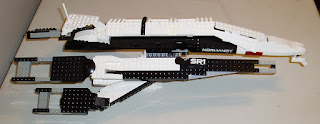
In case you hadn't figured it out, I also love Legos. In fact, I've dropped more than I'd like to consider on them this extended weekend. Massachusetts is, in fact, blessed with not one, but THREE Lego stores, two of which I visited. If you like Legos and don't want to mine them yourself in the hallowed plastic mines of Denmark, I can think of no better pilgrimage than visiting one of their centers of rampant consumerism.
You can probably already see where this is going. If not, turn on your images.

This is a fairly rookie attempt at modelling the SR1 in all of its pre-disintegrated glory. I do like the SR2 (leather seats!) but it lacks the spartan charm of the SR1. I was sad to see it go.
Sadly, I'm not super pleased with this rendition mostly because of the shape of the fuselage but I'm fairly limited in the scope that I can build by the available parts in my collection. My repeated trips to Lego stores this weekend (three trips to two different stores, in case you're wondering) might have something to do with said collection.
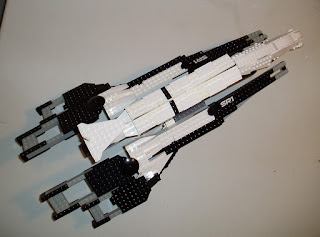
Lame excuses aside, it's by far the most technical of the (admittedly small number of) builds I've done. The wings are set at a very un-lego like angle both from front to back, and from top to bottom. The bottom thruster sub-assemblies are pretty sturdily attached to the wings with technic pegs. The (poorly executed) fuselage is a five walled construction. During its construction over the last six days (~40 hours) I've tried tons of different builds for just about every piece before settling on the build that you see pictured here.

Since I started, I've learned that there's an entire set of builders out there that are nothing less than phenomenal. They've gathered a palette of skills that are astounding. I've also learned that there are uses for pieces that I didn't even know existed (both the pieces, and the uses). So now, armed with a Lego VIP card and the ability to hit two separate stores in the same hour, I'm embarking on a quest to hone my Lego building skills to the point that I can build the Normandy in a more proper scale in a way that I'm pleased with.

In case you hadn't figured it out, I also love Legos. In fact, I've dropped more than I'd like to consider on them this extended weekend. Massachusetts is, in fact, blessed with not one, but THREE Lego stores, two of which I visited. If you like Legos and don't want to mine them yourself in the hallowed plastic mines of Denmark, I can think of no better pilgrimage than visiting one of their centers of rampant consumerism.
You can probably already see where this is going. If not, turn on your images.

This is a fairly rookie attempt at modelling the SR1 in all of its pre-disintegrated glory. I do like the SR2 (leather seats!) but it lacks the spartan charm of the SR1. I was sad to see it go.
Sadly, I'm not super pleased with this rendition mostly because of the shape of the fuselage but I'm fairly limited in the scope that I can build by the available parts in my collection. My repeated trips to Lego stores this weekend (three trips to two different stores, in case you're wondering) might have something to do with said collection.

Lame excuses aside, it's by far the most technical of the (admittedly small number of) builds I've done. The wings are set at a very un-lego like angle both from front to back, and from top to bottom. The bottom thruster sub-assemblies are pretty sturdily attached to the wings with technic pegs. The (poorly executed) fuselage is a five walled construction. During its construction over the last six days (~40 hours) I've tried tons of different builds for just about every piece before settling on the build that you see pictured here.

Since I started, I've learned that there's an entire set of builders out there that are nothing less than phenomenal. They've gathered a palette of skills that are astounding. I've also learned that there are uses for pieces that I didn't even know existed (both the pieces, and the uses). So now, armed with a Lego VIP card and the ability to hit two separate stores in the same hour, I'm embarking on a quest to hone my Lego building skills to the point that I can build the Normandy in a more proper scale in a way that I'm pleased with.
2010/01/24
It's a Crazy World We Live In
So I'm watching the New Orleans vs. Minnesota game; one that I'm kind of torn on. On the one hand, I'm a Brett fan, but on the other hand, I wouldn't mind seeing Brees and the Saints in the Big Game (TM). (And yes, I can call him by his first name since I lived in Madison for two years.) Anyway, football isn't what I'm here to talk about, not directly anyway, so feel free to breathe a sigh of relief.
Mass Effect 2 is one of the few games that I've ever really looked forward to (the other one: Supreme Commander). How much? Well, I just got through the game for a fourth time this weekend in preparation to transfer a high level character over. I started on Thursday. I'll probably play through again delaying my ME2 extravaganza in order to hit 60 because apparently you get more awesomeness if you transfer a 60. Since then, I've been watching football and Mass Effect trailers/videos most of the day.
ANYWAY
In the middle of the game there was a Mass Effect 2 commercial. "Wow", I'm thinking. "Is gaming finally mainstream enough that we can advertise during football?" Heavy. I mean, football is usually dominated by unmemorable beer and truck commercials. Imagine my surprise then to hear "the Mass Effect 2 first half stats" as announced by Troy Aikman (maybe Joe Buck?) indicating that EA's marketing campaign is spending big $$$s. That's cool, and not just because I'm excited about the game.
Ya know what? I hate EA. I hate them a LOT, and not just for what they did/are doing to one of my former employers. Even given that, I don't think I can deny that what they're doing helps bring legitimacy to the industry. That, in many ways, is cool.
Mass Effect 2 is one of the few games that I've ever really looked forward to (the other one: Supreme Commander). How much? Well, I just got through the game for a fourth time this weekend in preparation to transfer a high level character over. I started on Thursday. I'll probably play through again delaying my ME2 extravaganza in order to hit 60 because apparently you get more awesomeness if you transfer a 60. Since then, I've been watching football and Mass Effect trailers/videos most of the day.
ANYWAY
In the middle of the game there was a Mass Effect 2 commercial. "Wow", I'm thinking. "Is gaming finally mainstream enough that we can advertise during football?" Heavy. I mean, football is usually dominated by unmemorable beer and truck commercials. Imagine my surprise then to hear "the Mass Effect 2 first half stats" as announced by Troy Aikman (maybe Joe Buck?) indicating that EA's marketing campaign is spending big $$$s. That's cool, and not just because I'm excited about the game.
Ya know what? I hate EA. I hate them a LOT, and not just for what they did/are doing to one of my former employers. Even given that, I don't think I can deny that what they're doing helps bring legitimacy to the industry. That, in many ways, is cool.
Subscribe to:
Posts (Atom)